Who gets the EURO 2028 qualifying group of death? We ran the draw 50,000 times
19 November 2026
Watch: We simulated the EURO 2028 qualifiers draw 50K times
The video in 10 minutes, or read on for the full tables.
Spain, Switzerland, Scotland and Finland, in one qualifying group. Or England, Austria, Poland and Bulgaria. Both can happen when UEFA draws the EURO 2028 qualifying groups on Sunday 6 December, at 18:00 CET in Belfast.
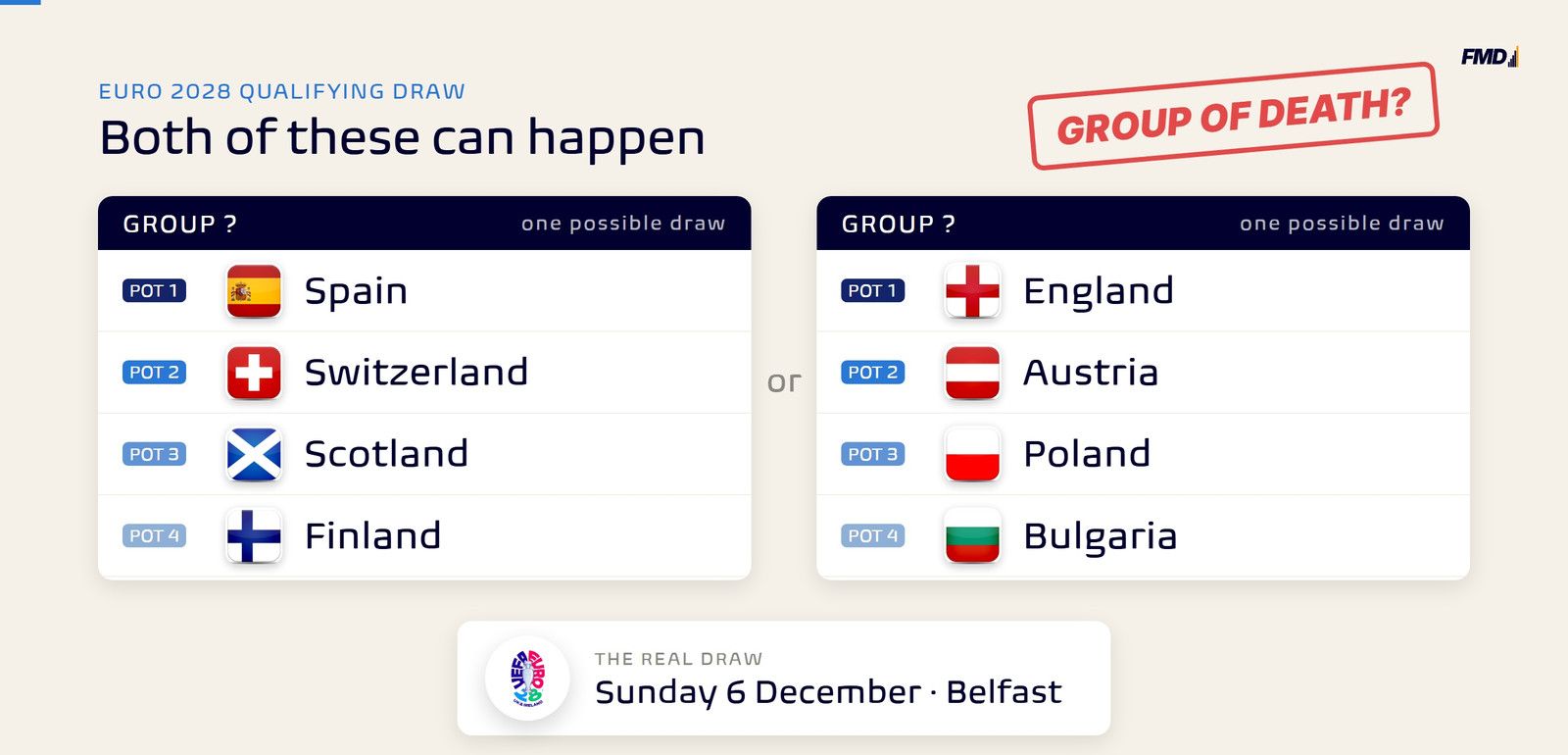
So who is most likely to get the group of death? It isn't simply the biggest names. It comes down to a clash with the Nations League calendar, and a rule most fans have never heard of. We ran the draw 50,000 times with UEFA's own list of restrictions to find out.
Fifty-four teams, twelve groups, two sizes
Fifty-four teams are in the draw: every UEFA nation except Russia, who are still suspended. That includes the four hosts, England, Scotland, Wales and the Republic of Ireland. Hosting doesn't put you straight through: they play like everyone else, with a safety net we'll come back to.
The teams are drawn into twelve groups. Groups A to F have four teams, groups G to L have five, and everyone plays home and away.
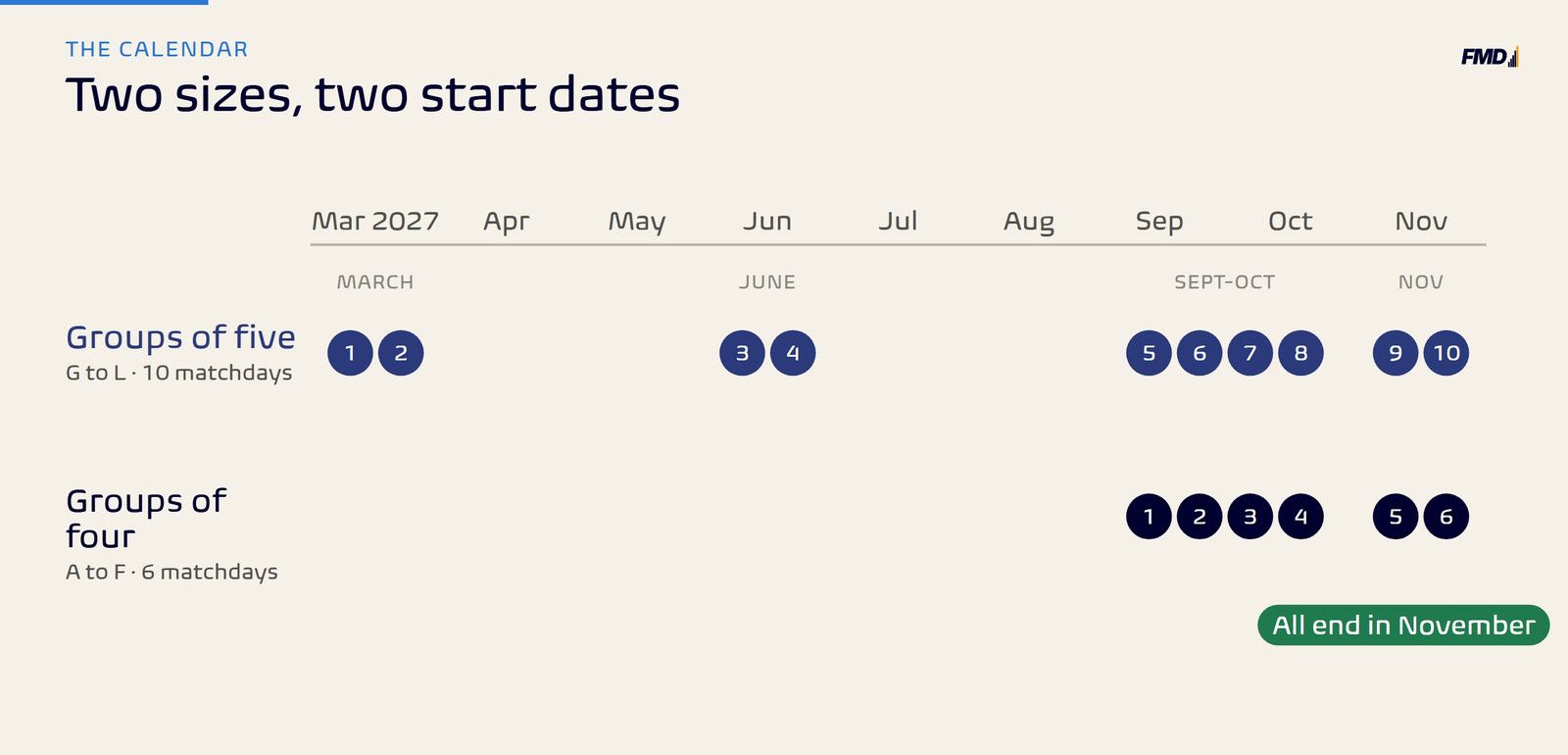
The two sizes don't start at the same time. Groups of five start in March 2027 and play ten matchdays. Groups of four start in September and play six. They all finish in November 2027.
The pots
The pots come straight from the Nations League ranking after the league phase: the top twelve in Pot 1, the next twelve in Pot 2, then Pots 3 and 4, and the six League D teams in Pot 5. These are UEFA's official pots.
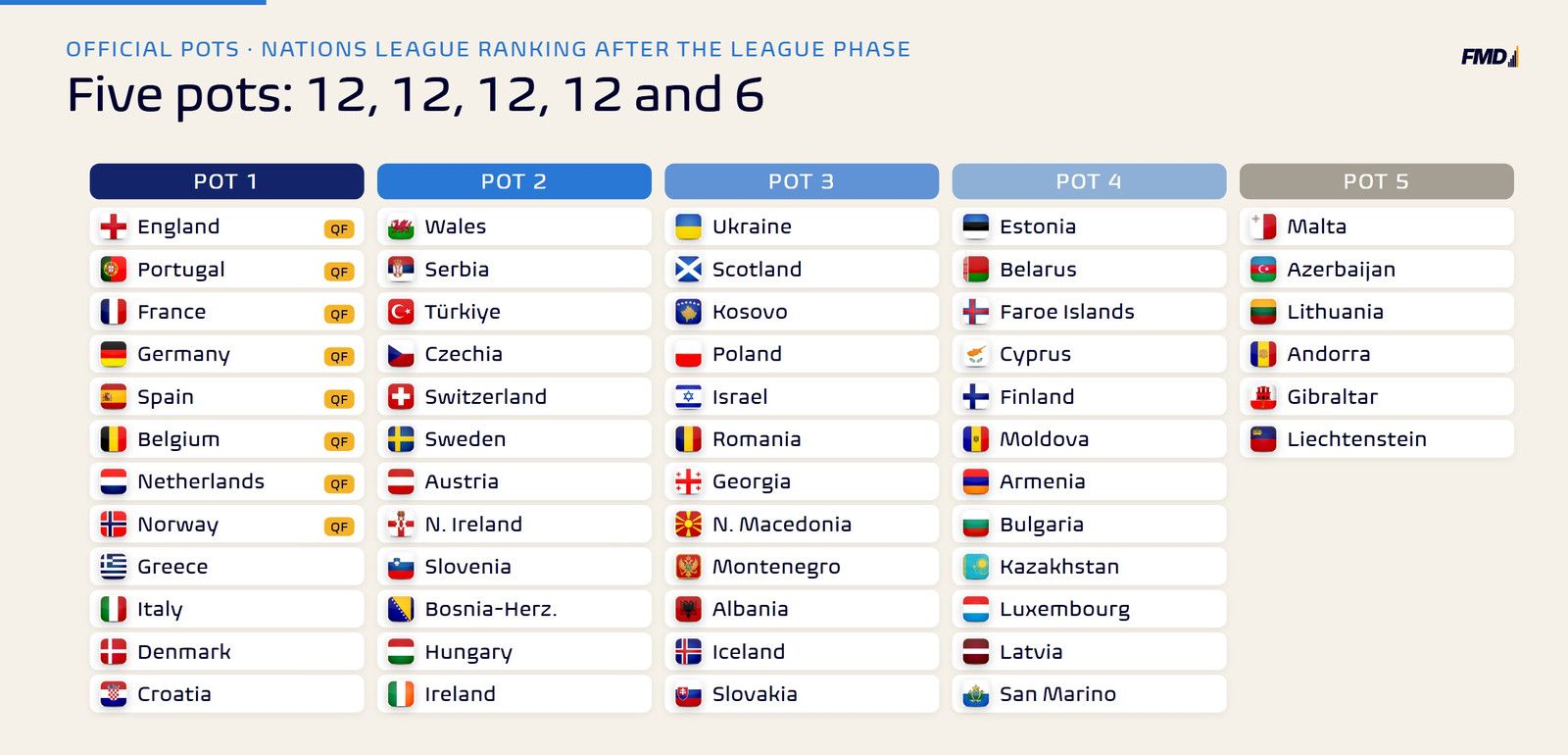
| Pot 1 | Pot 2 | Pot 3 | Pot 4 | Pot 5 |
|---|---|---|---|---|
| England (QF) | Wales (PO) | Ukraine | Estonia (PO) | Malta |
| Portugal (QF) | Serbia (PO) | Scotland | Belarus (PO) | Azerbaijan |
| France (QF) | Türkiye | Kosovo | Faroe Islands (PO) | Lithuania |
| Germany (QF) | Czechia | Poland | Cyprus (PO) | Andorra |
| Spain (QF) | Switzerland | Israel (PO) | Finland | Gibraltar |
| Belgium (QF) | Sweden | Romania (PO) | Moldova | Liechtenstein |
| Netherlands (QF) | Austria | Georgia (PO) | Armenia | |
| Norway (QF) | Northern Ireland | North Macedonia (PO) | Bulgaria | |
| Greece | Slovenia (PO) | Montenegro | Kazakhstan | |
| Italy | Bosnia and Herzegovina (PO) | Albania | Luxembourg | |
| Denmark (PO) | Hungary (PO) | Iceland | Latvia | |
| Croatia (PO) | Republic of Ireland (PO) | Slovakia | San Marino |
QF = Nations League quarter-finalist, PO = in the Nations League promotion and relegation play-offs in March 2027.
Notice one name in Pot 2: Switzerland. On our ratings, they're stronger than seven of the twelve teams in Pot 1. Keep that in mind.
The restrictions
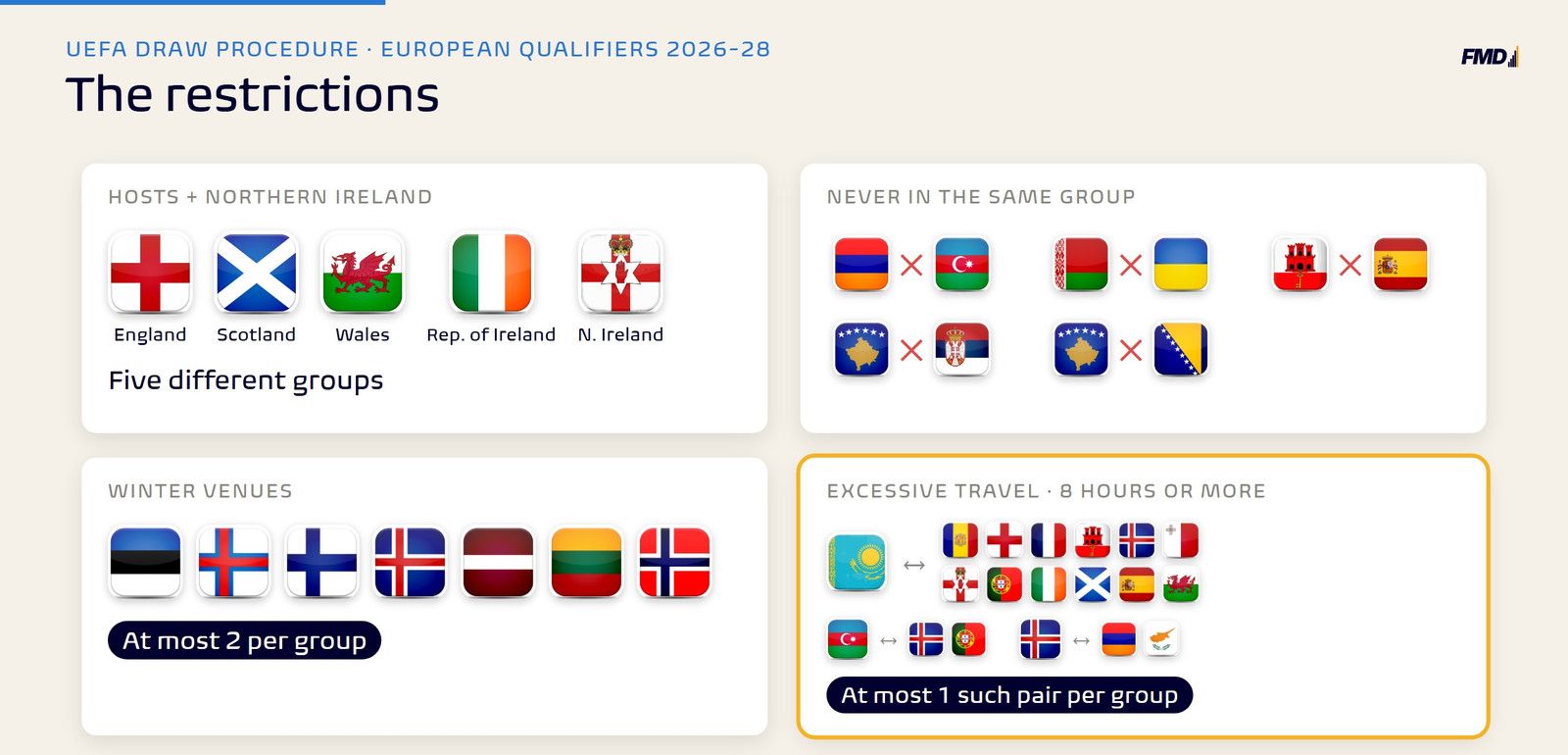
- The hosts. England, Scotland, Wales and the Republic of Ireland, plus Northern Ireland, all go into different groups.
- Pairs UEFA keeps apart for political reasons: Armenia and Azerbaijan, Belarus and Ukraine, Gibraltar and Spain, and Kosovo with Serbia, or with Bosnia and Herzegovina.
- Winter venues. Seven countries count as winter venues, from Iceland and the Faroe Islands to Finland and Norway, and a group can have at most two of them.
- Travel. Some trips are simply too long, like Kazakhstan to Lisbon or Reykjavik. A group can have only one of those pairs.
The rule that shapes everything
In March 2027, 24 of these teams are still busy in the Nations League: the eight quarter-finalists, and the sixteen teams in the promotion and relegation play-offs. The four quarter-final winners then play the Finals in June.
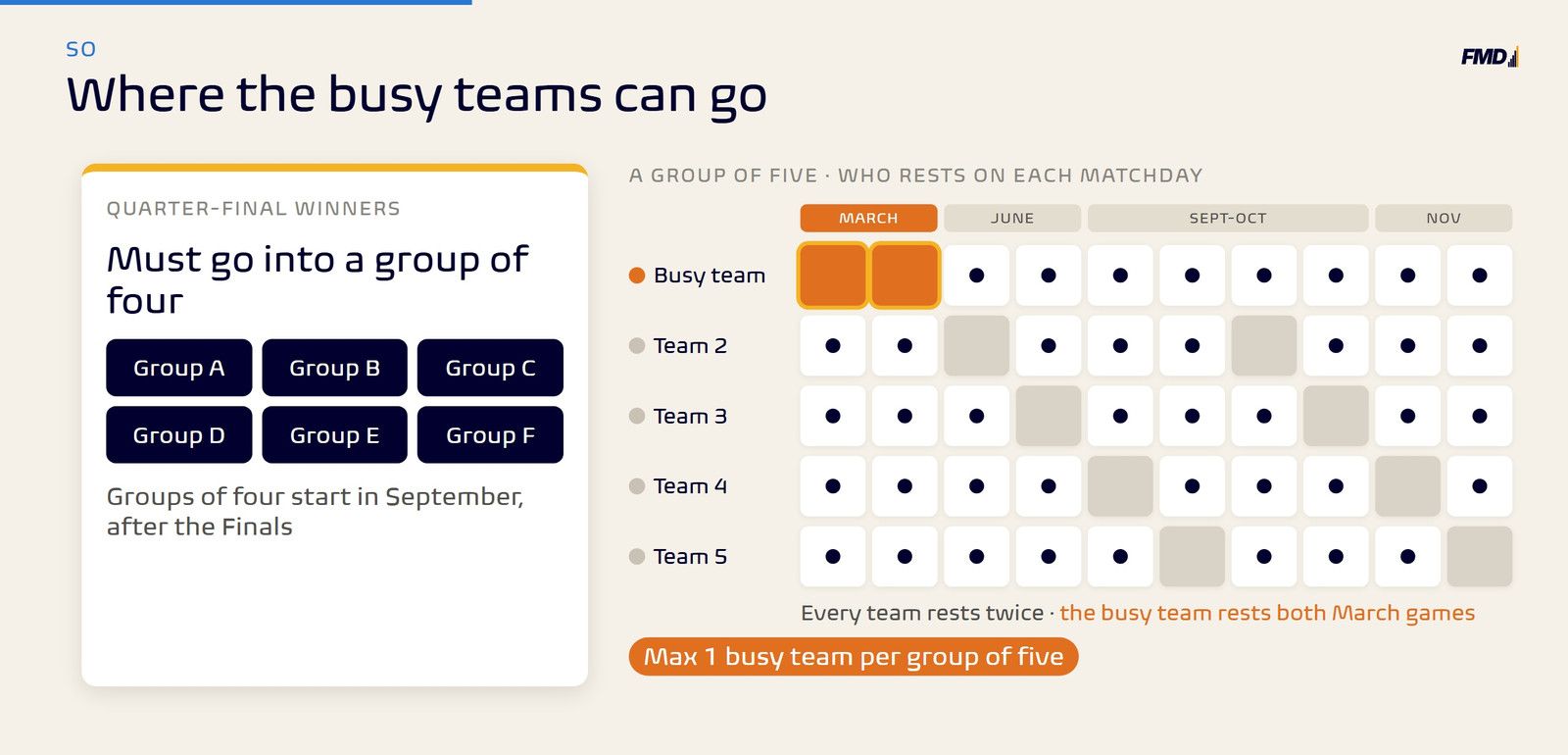
So the quarter-final winners must go into groups of four, which only start in September. And a group of five can take just one busy team. In a group of five, every team sits out two matchdays, and that team sits out both games in March.
There's a twist. On draw day nobody knows who wins those quarter-finals (the pairings themselves are drawn on 20 November), so the balls say "winner of quarter-final one" and "loser of quarter-final one". Any restriction on either team applies to both balls. So Gibraltar can't draw Spain, or whoever Spain play in the quarter-finals.
The draw itself goes pot by pot. Each team goes into the first group, in alphabetical order, where it fits and where the rest of the draw can still be completed. A computer checks that for every ball.
One draw, ball by ball
Here's one of our draws, with one possible set of quarter-final pairings. The four quarter-final winners take four of the six groups of four, and the busy teams spread out from there.
- Northern Ireland come out early in Pot 2, but group A is off limits: it holds the loser of England against Norway, and on draw day that ball could be England. So they go to group B.
- Hungary skip groups G and H, which already have a busy team. Kosovo can't join Serbia. Scotland can't join the Republic of Ireland.
- Kazakhstan can't go to group F: with Portugal and the Republic of Ireland there, that's two long trips.
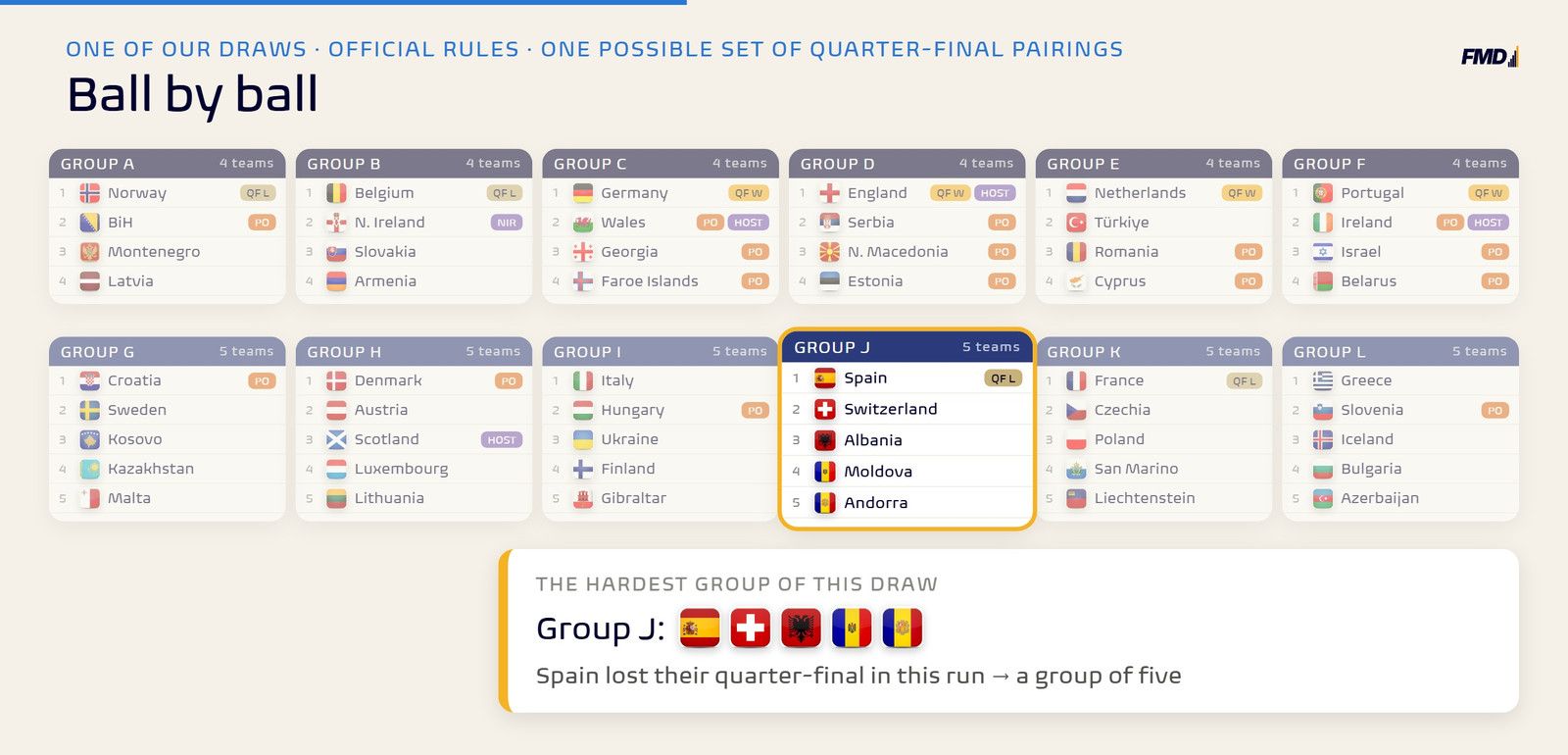
| Group | Size | Teams |
|---|---|---|
| A | 4 | Norway, Bosnia and Herzegovina, Montenegro, Latvia |
| B | 4 | Belgium, Northern Ireland, Slovakia, Armenia |
| C | 4 | Germany (QF winner), Wales, Georgia, Faroe Islands |
| D | 4 | England (QF winner), Serbia, North Macedonia, Estonia |
| E | 4 | Netherlands (QF winner), Türkiye, Romania, Cyprus |
| F | 4 | Portugal (QF winner), Republic of Ireland, Israel, Belarus |
| G | 5 | Croatia, Sweden, Kosovo, Kazakhstan, Malta |
| H | 5 | Denmark, Austria, Scotland, Luxembourg, Lithuania |
| I | 5 | Italy, Hungary, Ukraine, Finland, Gibraltar |
| J (hardest) | 5 | Spain, Switzerland, Albania, Moldova, Andorra |
| K | 5 | France, Czechia, Poland, San Marino, Liechtenstein |
| L | 5 | Greece, Slovenia, Iceland, Bulgaria, Azerbaijan |
Twelve groups, every rule respected. The hardest one here is group J: Spain, Switzerland, Albania, Moldova and Andorra. Spain lost their quarter-final in this run, so they went to a group of five, right next to Switzerland.
You can run this draw yourself on our free EURO 2028 qualifying draw simulator: pick your team, press Run the draw, and the balls come out one by one. In the video, Scotland get Spain, Serbia and Estonia, and the verdict is a nightmare draw, harder than 96.2% of their possible draws. With a Basic plan you also get the probabilities: who your team can get, your chance of a group of four, and every possible opponent, pot by pot.
Who ends up in a group of four?
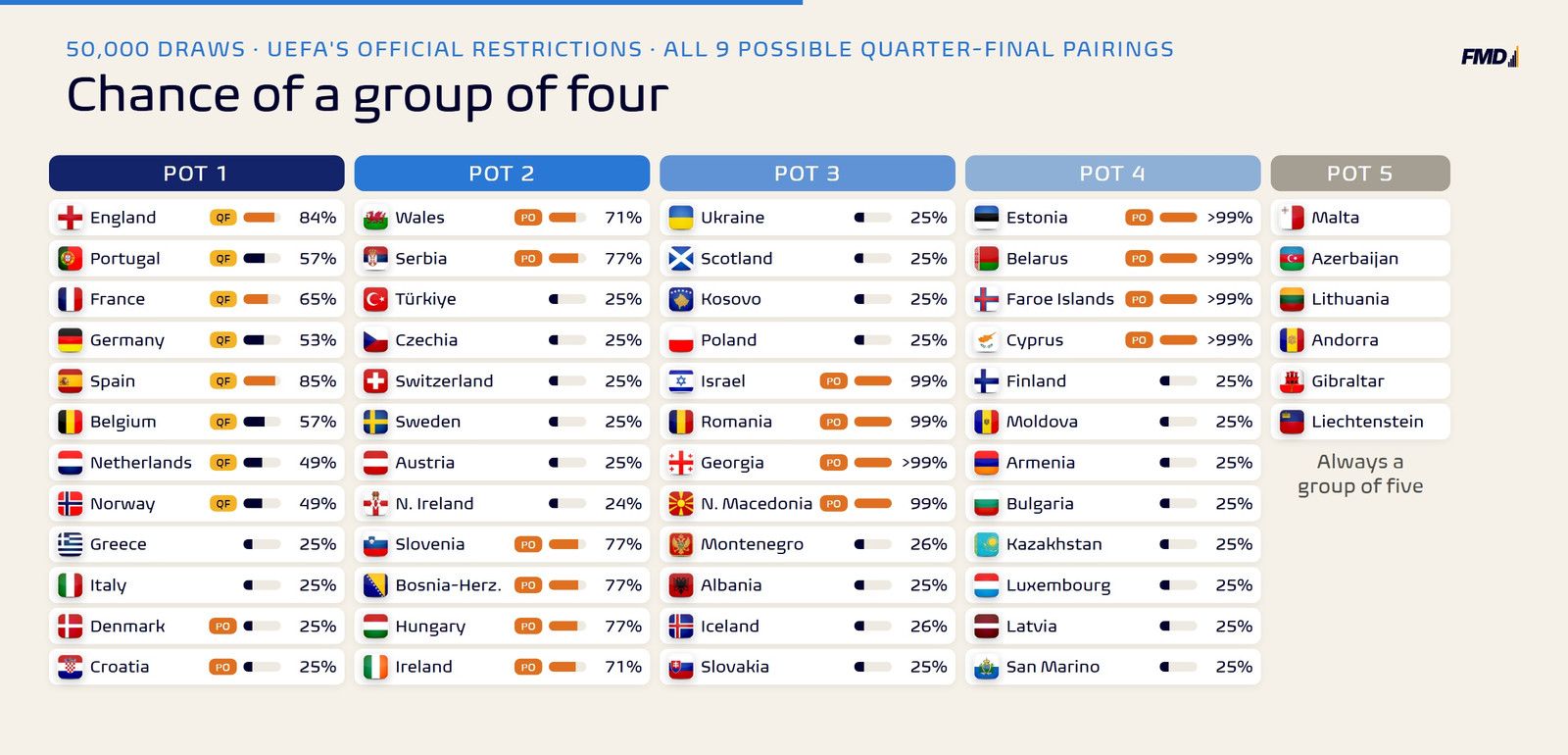
We ran the draw 50,000 times, with UEFA's list of restrictions and every possible quarter-final pairing, since those come from a separate draw on 20 November.
| Pot 1 | Group of four | Pot 2 | Group of four |
|---|---|---|---|
| England (QF) | 83.6% | Wales (PO) | 71.4% |
| Portugal (QF) | 57.3% | Serbia (PO) | 77.3% |
| France (QF) | 65.4% | Türkiye | 24.8% |
| Germany (QF) | 53.4% | Czechia | 25.0% |
| Spain (QF) | 85.1% | Switzerland | 24.6% |
| Belgium (QF) | 56.8% | Sweden | 24.7% |
| Netherlands (QF) | 49.4% | Austria | 24.7% |
| Norway (QF) | 49.4% | Northern Ireland | 24.2% |
| Greece | 25.0% | Slovenia (PO) | 77.4% |
| Italy | 24.8% | Bosnia and Herzegovina (PO) | 77.5% |
| Denmark (PO) | 25.0% | Hungary (PO) | 77.1% |
| Croatia (PO) | 24.8% | Republic of Ireland (PO) | 71.4% |
- Pot 1: the likely quarter-final winners lead, Spain 85.1% and England 83.6%. Greece, Italy, Denmark and Croatia, about one in four.
- Pots 3 and 4 are black and white. The eight play-off teams, Israel, Romania, Georgia and North Macedonia, Estonia, Belarus, the Faroe Islands and Cyprus, land in a group of four at least 99% of the time. Everyone else: about one in four.
- Pot 5 always goes into the groups of five.
Why? The groups of five can hide only six busy teams, one each, and Pot 1's busy teams fill most of those seats: 4.5 of the six on average. Pot 2 is drawn next and takes what's left, about 1.5. So Pot 2's play-off teams get a group of five about one time in four, and those in Pots 3 and 4 almost never.
The group of death
We measure every group by the average rating of its three best teams: three good sides fighting for two direct places. In each draw one group comes out hardest. Who's in it?
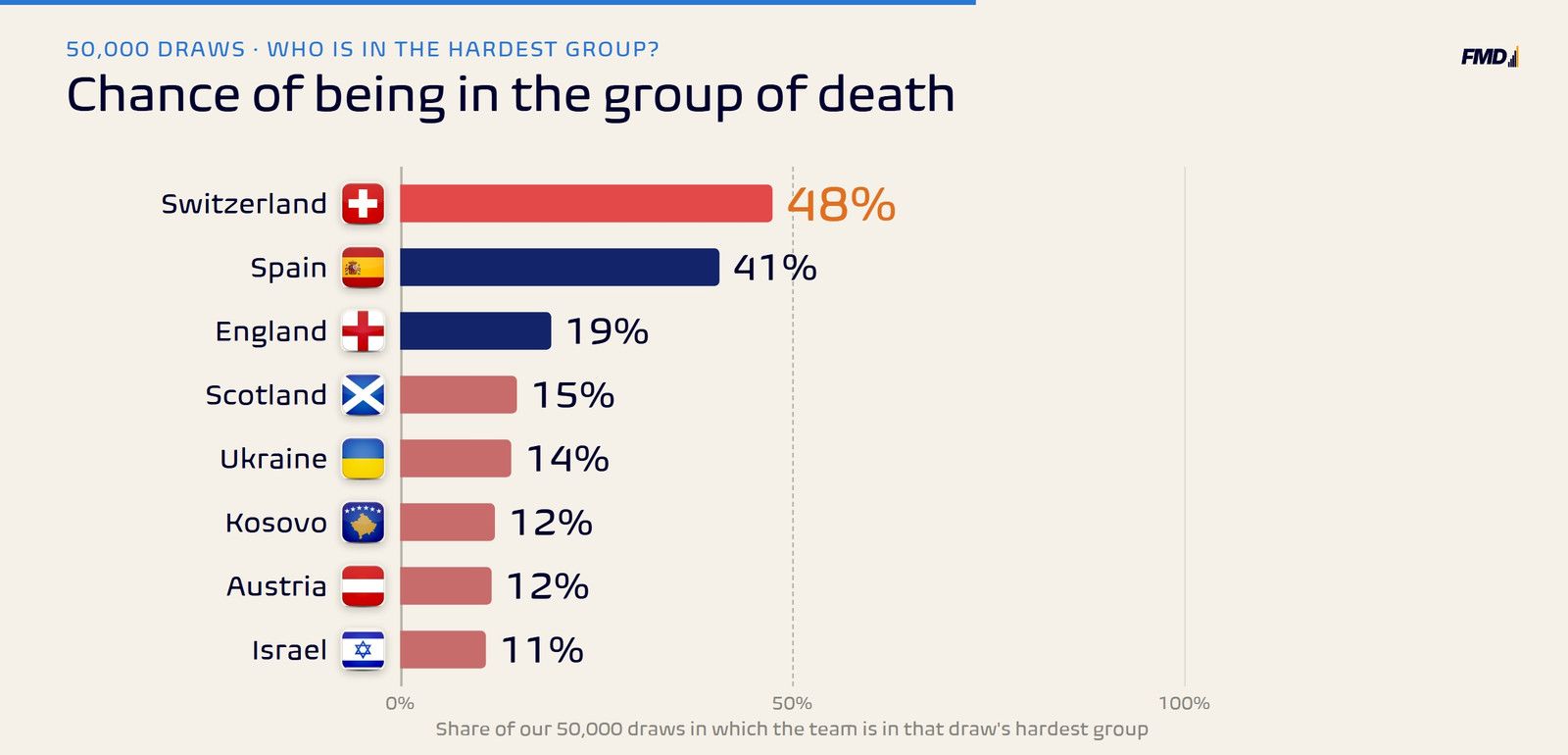
| Team | Pot | In the group of death |
|---|---|---|
| Switzerland | 2 | 47.5% |
| Spain | 1 | 40.7% |
| England | 1 | 19.2% |
| Scotland | 3 | 14.9% |
| Ukraine | 3 | 14.2% |
| Kosovo | 3 | 12.1% |
| Austria | 2 | 11.6% |
| Israel | 3 | 10.9% |
| Poland | 3 | 9.7% |
| Lithuania | 5 | 9.2% |
Most often, Switzerland: 47.5% of our draws, almost half. They're the strongest team in Pot 2 by a distance, so whichever group they join tends to be the hardest. From Pot 1 it's Spain, about two times in five, then England, about one in five. Greece, the lowest-rated team in Pot 1, almost never.
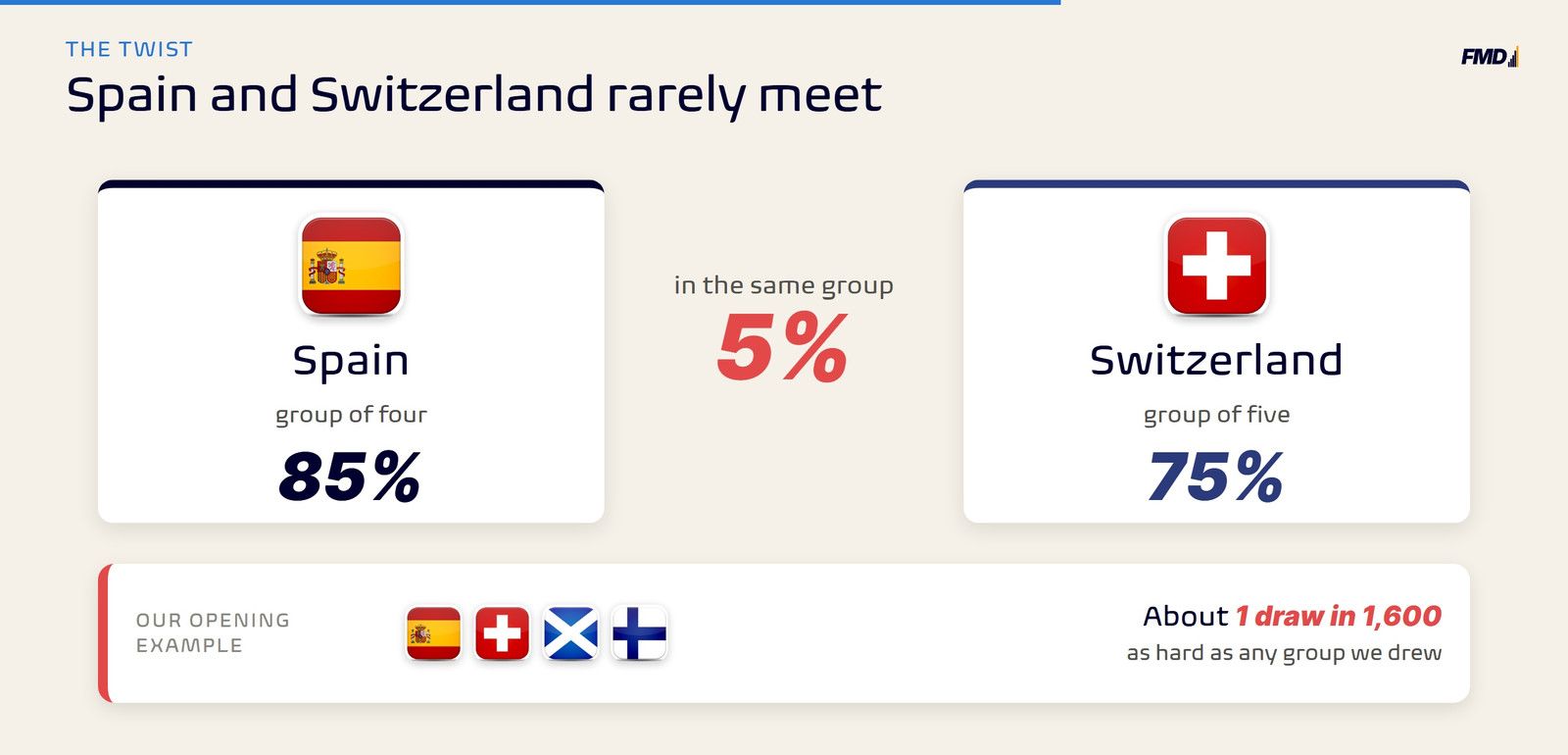
But Spain and Switzerland together? Only 4.9%. Spain usually win their quarter-final and go to a group of four. Switzerland aren't busy in March, so three times in four they go to a group of five. That's why our opening example, Spain, Switzerland, Scotland and Finland, as hard as any group we drew, came up in only 32 of 50,000 draws, about once in every 1,600. England, Austria, Poland and Bulgaria came up 28 times.
The hardest group of all our draws: Spain, Switzerland, Ukraine, Kazakhstan, Liechtenstein, again with Spain as a quarter-final loser. And the group of death is close to a coin flip between the two sizes: a group of five 51.9% of the time, a group of four 48.1%.
Scotland: every possible opponent
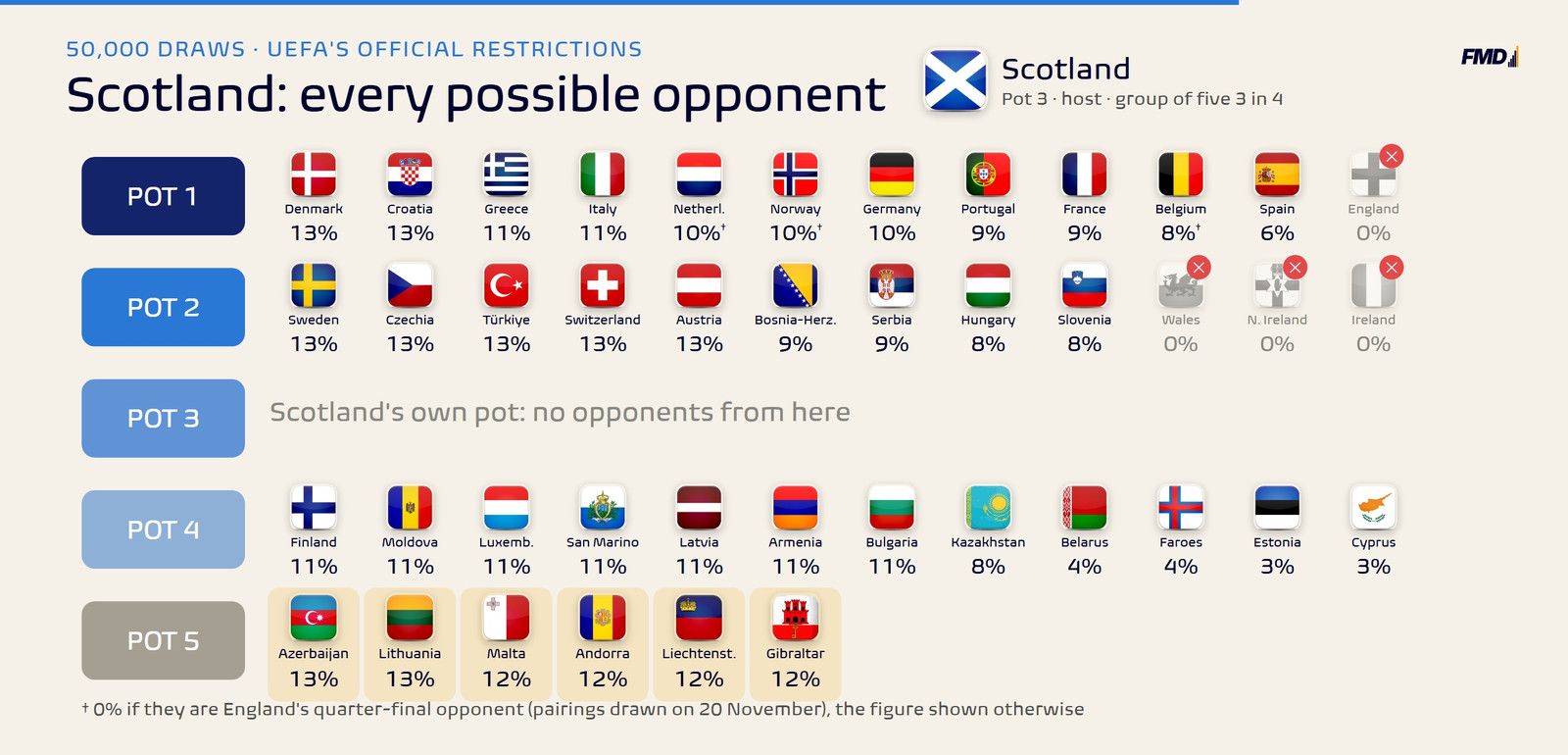
| Pot 1 | Chance | Pot 2 | Chance | Pot 4 | Chance |
|---|---|---|---|---|---|
| England | never | Wales | never | Estonia | 3.5% |
| Portugal | 9.5% | Serbia | 8.6% | Belarus | 3.6% |
| France | 8.5% | Türkiye | 13.3% | Faroe Islands | 3.5% |
| Germany | 9.7% | Czechia | 13.3% | Cyprus | 3.5% |
| Spain | 6.2% | Switzerland | 13.1% | Finland | 11.3% |
| Belgium | 5.6%* | Sweden | 13.3% | Moldova | 11.2% |
| Netherlands | 6.6%* | Austria | 13.0% | Armenia | 11.0% |
| Norway | 6.5%* | Northern Ireland | never | Bulgaria | 10.8% |
| Greece | 10.5% | Slovenia | 8.1% | Kazakhstan | 8.3% |
| Italy | 10.5% | Bosnia and Herzegovina | 8.8% | Luxembourg | 11.2% |
| Denmark | 13.2% | Hungary | 8.5% | Latvia | 11.1% |
| Croatia | 13.2% | Republic of Ireland | never | San Marino | 11.1% |
* 0% when they are England's quarter-final opponent (pairings drawn on 20 November), otherwise Belgium 8.4%, Netherlands 9.8%, Norway 9.7%.
Pot 5: Malta 12.4%, Azerbaijan 13.4%, Lithuania 12.9%, Andorra 12.4%, Gibraltar 11.9%, Liechtenstein 12.3%, but only if Scotland get a group of five.
- Pot 1: never England, because of the hosts rule, and never England's quarter-final opponent either, for the same reason. Spain are the least likely of the rest, 6.2%: they usually go to a group of four, while Scotland, not busy in March, go to a group of five three times in four. Denmark and Croatia are the likeliest, about 13% each.
- Pot 2: never Wales, the Republic of Ireland or Northern Ireland. Sweden, Czechia, Türkiye, Switzerland and Austria, about 13% each; the play-off teams, Serbia, Bosnia and Herzegovina, Hungary and Slovenia, only about 8 to 9%.
- Pot 4: Estonia, Belarus, the Faroe Islands and Cyprus, about 3.5% each, because they're always in a group of four. Kazakhstan 8.3%: that's the travel rule again.
And after the groups?
The twelve group winners and the eight best runners-up go straight to EURO 2028. In the runner-up ranking, results against the team that finishes fifth don't count.
Two more places are kept for hosts who don't make it directly. If two or more of them miss out, the best two by the rankings take those places. Whatever's left, between two and four places, goes to the play-offs in March 2028: the lowest-ranked runners-up, and the rest from the Nations League. First the group winners of Leagues A, B and C who aren't through yet, then the best League D winner, Malta, then the next best in the ranking. More in our post on the qualifying format and the play-offs.
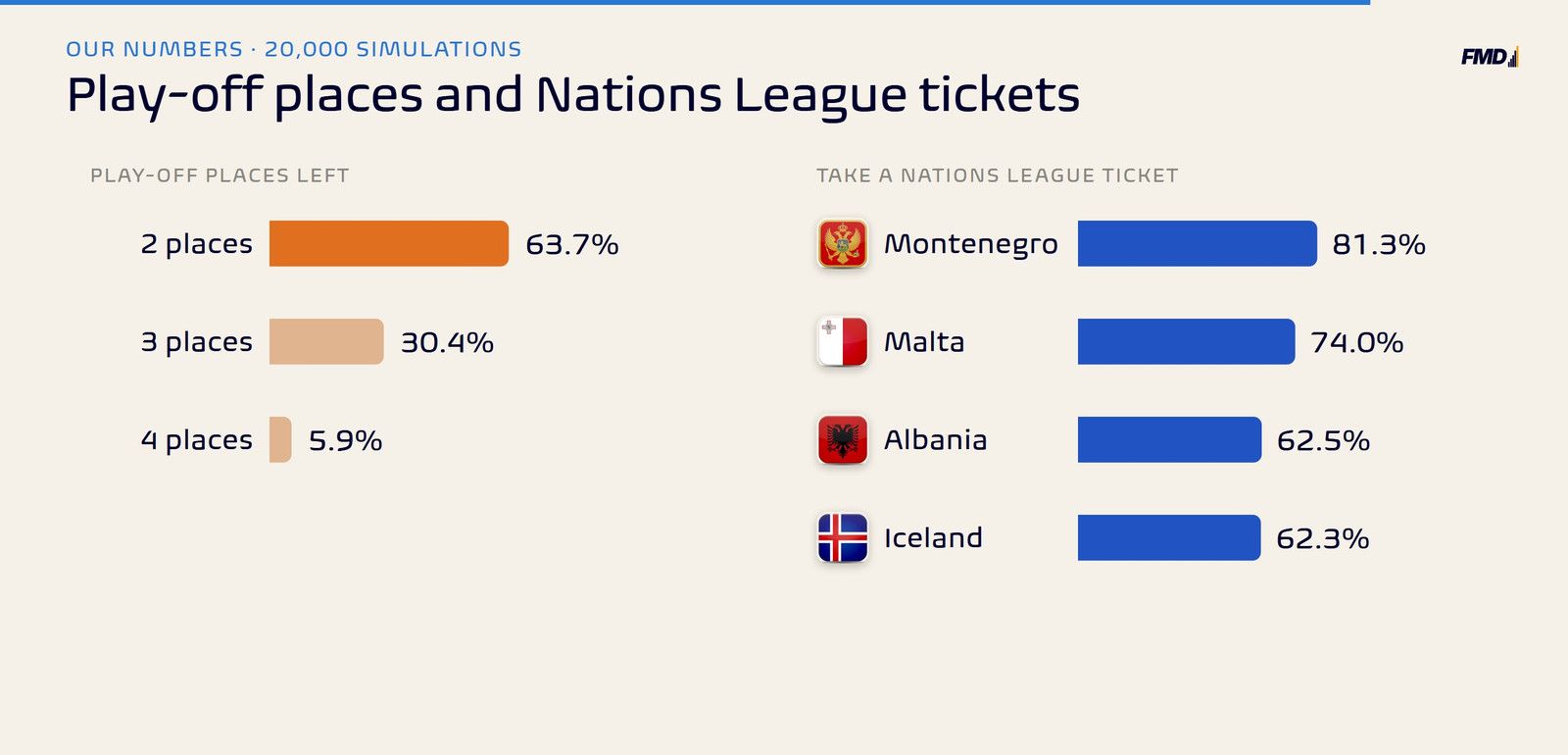
| Play-off places | Chance |
|---|---|
| 2 | 63.7% |
| 3 | 30.4% |
| 4 | 5.9% |
| Most likely to take a Nations League ticket | Chance |
|---|---|
| Montenegro | 81.3% |
| Malta | 74.0% |
| Albania | 62.5% |
| Iceland | 62.3% |
| Slovakia | 56.2% |
| Northern Ireland | 38.3% |
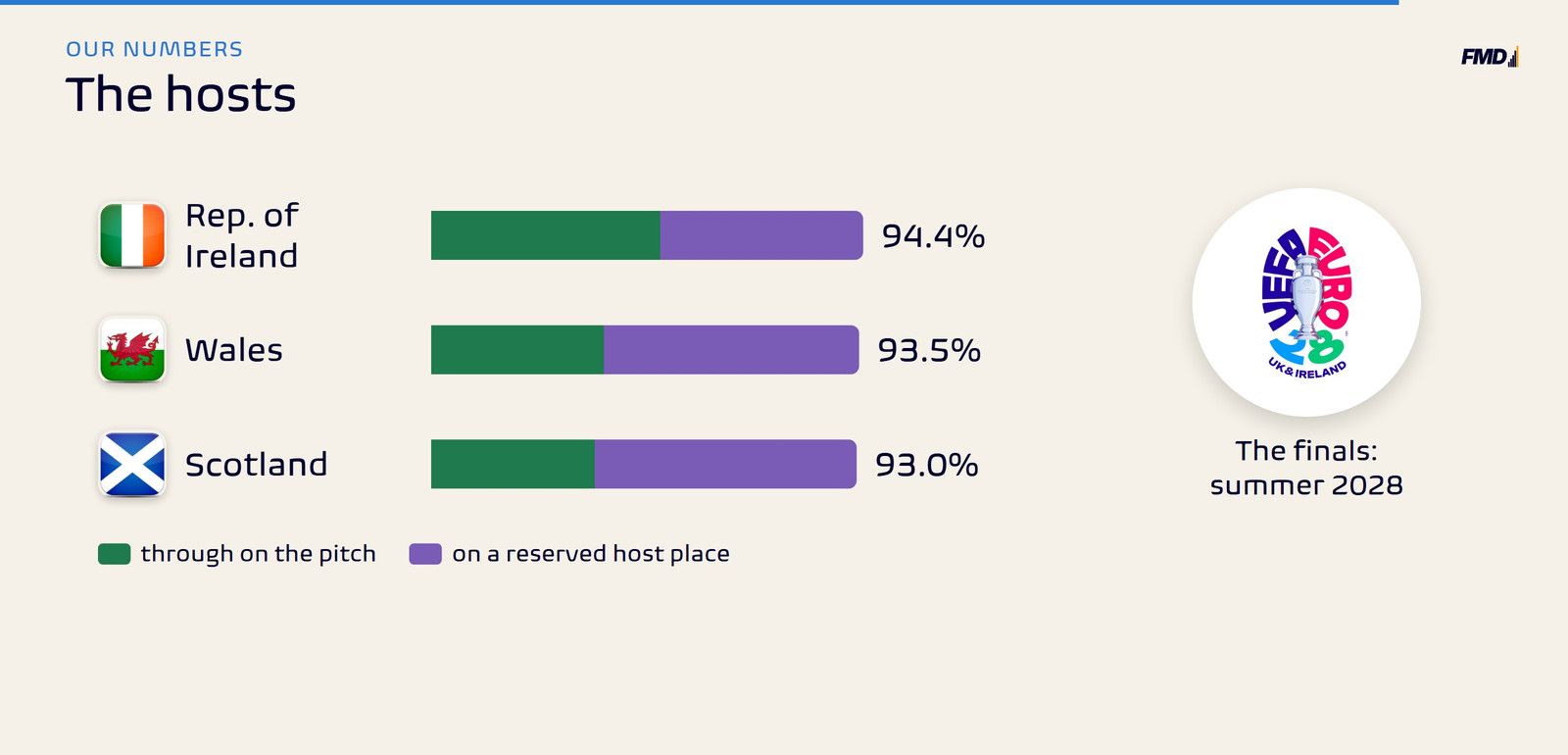
| Host | Qualify for EURO 2028 | Of which on a reserved host place |
|---|---|---|
| Republic of Ireland | 94.4% | 44.3% |
| Wales | 93.5% | 55.8% |
| Scotland | 93.0% | 57.3% |
The Republic of Ireland, Wales and Scotland each qualify more than nine times in ten on our numbers, largely thanks to that safety net. The finals are in the summer of 2028.
To sum up
Twelve groups, five pots, and a calendar that pushes the busy teams into groups of four. The likeliest group of death is wherever Switzerland land, and the biggest danger in Pot 1 is Spain, only they rarely meet.
Over to you: which group would you call the group of death? And which team do you want your country to avoid? Tell us in the comments under the video.
Follow it on football-md.com
Run the draw yourself as many times as you like on our free EURO 2028 qualifying draw simulator (the probabilities come with a Basic plan; more on it in our post on the draw simulator), and follow the last games before the draw in the UEFA Nations League, with the live tables and every team's chances.
Rules: UEFA's draw procedure for the European Qualifiers 2026-28 (official pots, hosts and Northern Ireland apart, quarter-final winners in groups of four, at most one busy team per group of five, prohibited clashes, winter venues, excessive travel, a quarter-final team's restrictions applied to its whole pairing). Draw numbers: 50,000 draws with our draw engine and UEFA's official list of restrictions, spread evenly over the nine possible quarter-final pairings; group of death = the group with the highest average rating of its three best teams, on our ratings. Example draw: one run with one set of pairings. Qualifying numbers: our Nations League simulations of 18 November 2026, 20,000 runs.
📲 Follow the EURO 2028 draw from your phone
Install the Football Meets Data app to have the draw simulator, the Nations League tables and every team's EURO 2028 chances one tap away. It takes a few seconds:
Android: open football-md.com in Chrome, tap the menu (⋮) and choose Install app.
iPhone: open football-md.com in Safari, tap Share and choose Add to Home Screen.
▶️ We're on YouTube
Watch next: could a EURO 2028 host miss its own EURO? Subscribe to our channel so you never miss one.