Should CONCACAF and CONMEBOL merge? We replayed the 2026 World Cup qualifiers as one campaign
19 November 2026
Watch: Should CONCACAF and CONMEBOL merge?
The video in 11 minutes, or read on for the full tables.
A year ago, Curaçao became the smallest country ever to qualify for a World Cup. Haiti went too, for the first time since 1974. Two of the best stories of the whole cycle.
Now imagine they'd had to get past Chile, Peru and Venezuela to get there. Because there's an idea that keeps coming back: merge the qualifiers of North and Central America with South America's, and play one campaign for the whole of the Americas.
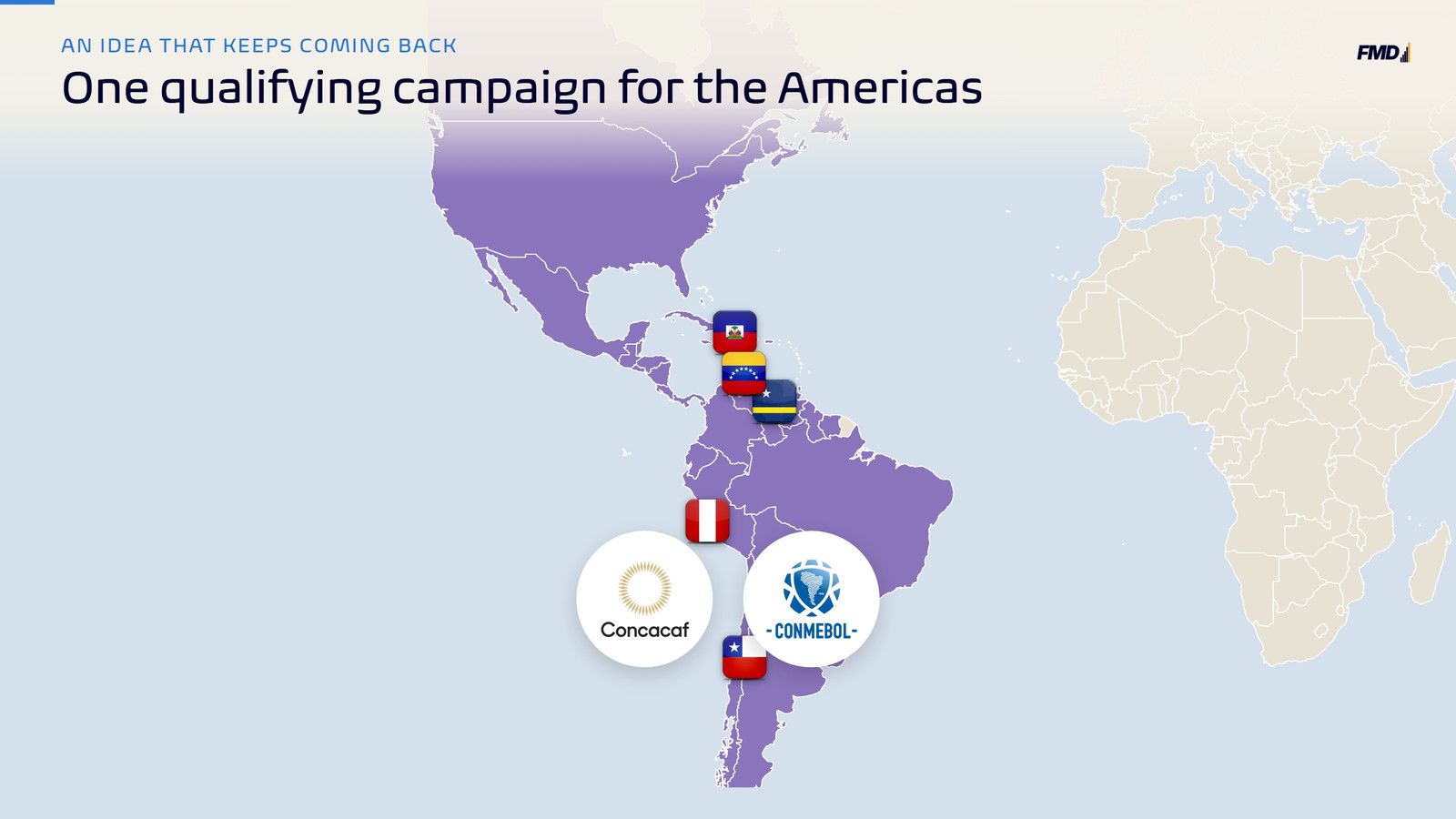
We replayed the 2026 qualifiers that way, 20,000 times. Who would make it, who would lose their place, and whether it's actually a good idea.
Why it keeps coming up
The World Cup has grown from 32 teams to 48. South America got six direct places and a play-off ticket, for ten teams.
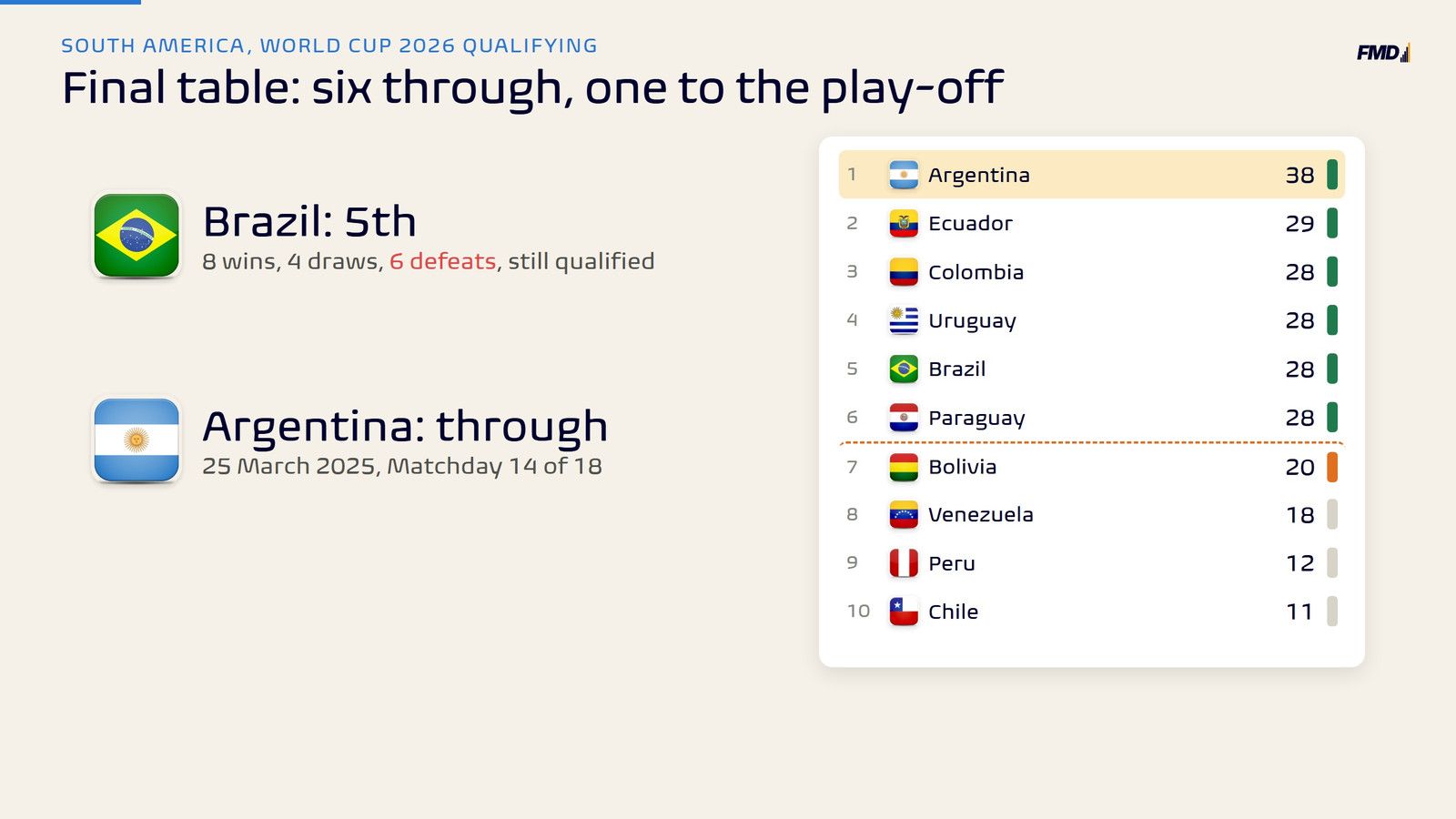
| South America, 2026 qualifying | Points | |
|---|---|---|
| 1 | Argentina | 38 |
| 2 | Ecuador | 29 |
| 3 | Colombia | 28 |
| 4 | Uruguay | 28 |
| 5 | Brazil | 28 |
| 6 | Paraguay | 28 |
| 7 | Bolivia | 20 |
| 8 | Venezuela | 18 |
| 9 | Peru | 12 |
| 10 | Chile | 11 |
Brazil finished fifth, lost six of their eighteen games, and still qualified with room to spare. Argentina were through on 25 March 2025, with four matchdays still to play.
And it could get emptier. South America's confederation has asked FIFA for a 64-team World Cup, and FIFA has been studying it. In the split from our post on a 64-team World Cup, South America would get eight places. Eight, out of ten.
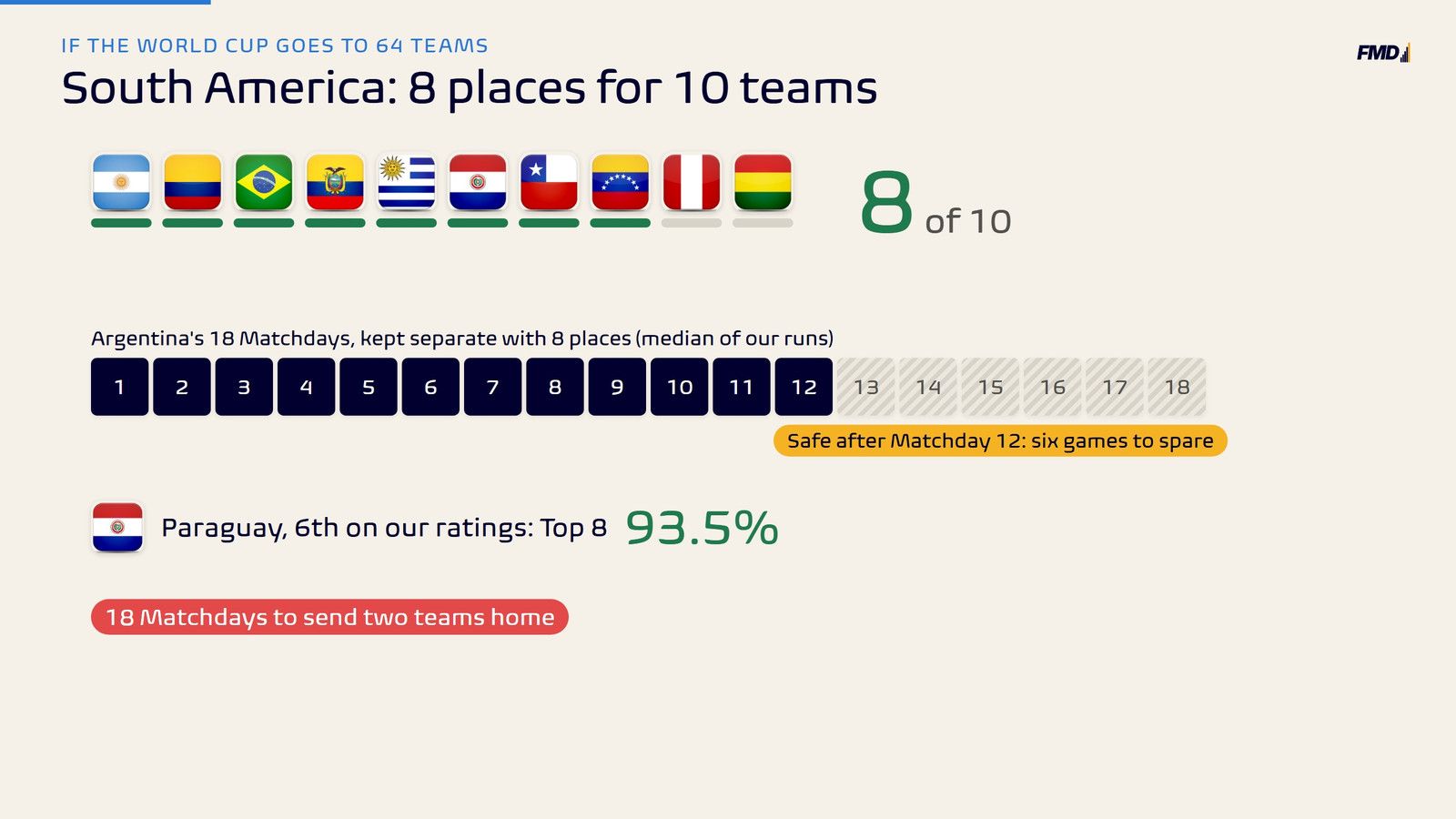
We played that out too. With eight places, Argentina would usually be safe after Matchday 12.0, with six still to play, and even Paraguay, sixth on our ratings, would get through 93.5% of the time. Eighteen matchdays, to send two teams home.
North and Central America have the opposite problem. 35 teams. In 2026 the three hosts sat out, so 32 teams played for three direct places and two play-off tickets.
Not a new idea
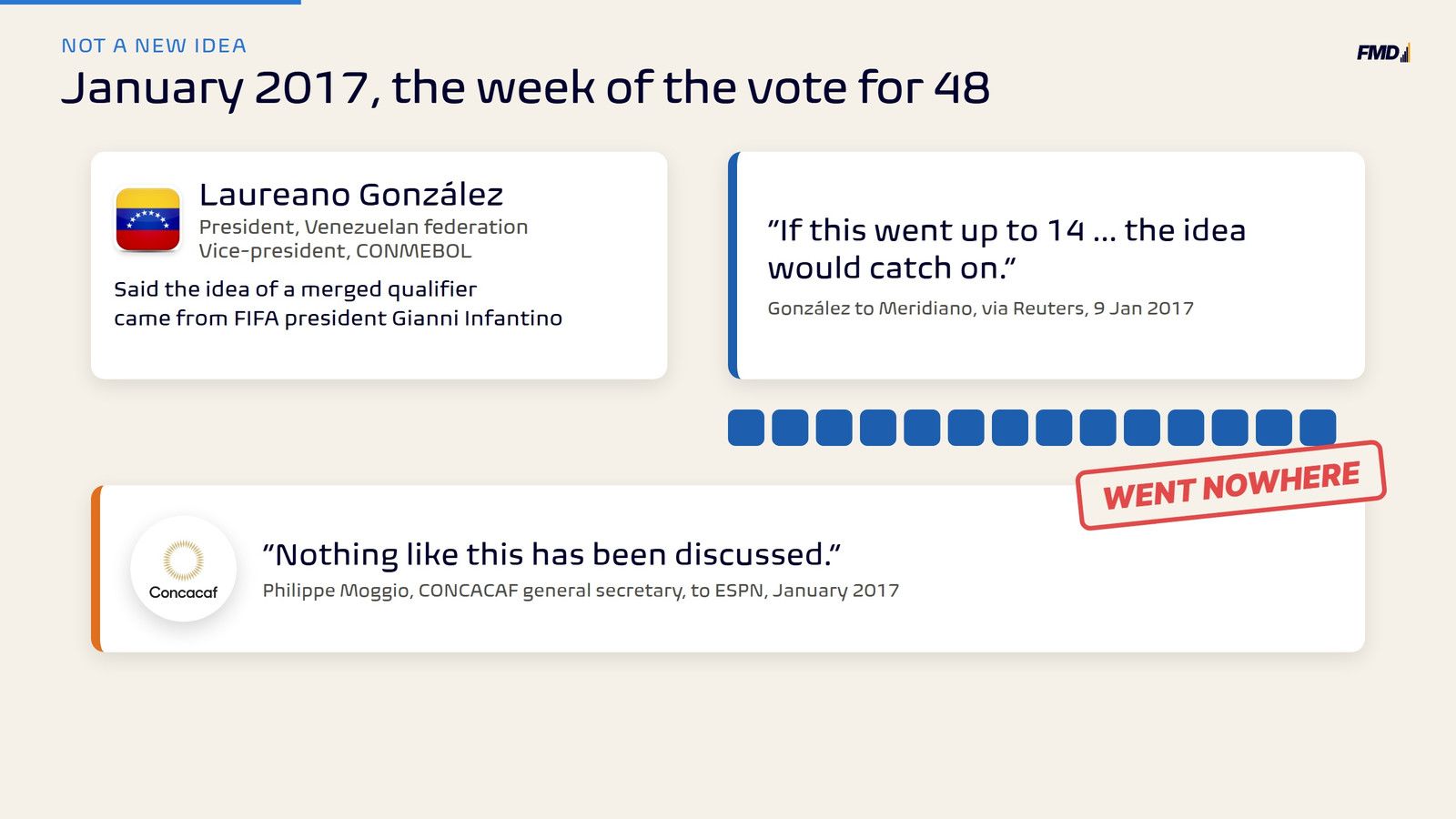
In January 2017, the week FIFA voted for 48 teams, Venezuela's federation president Laureano González, also a CONMEBOL vice-president, said Gianni Infantino had floated exactly this. His condition: give the two regions fourteen places between them, and the idea would catch on. CONCACAF's general secretary, Philippe Moggio, said nothing like it had been discussed. And it went nowhere.
Now look at 2026. The two confederations had twelve places between them, the three hosts included, plus three play-off tickets. That's close to what González asked for.
And the two already mix. The Copa América invited CONCACAF teams and was played in the United States, in 2016 and again in 2024. And in 2006 Australia left Oceania for Asia, to play stronger teams. Moving confederations has been done before.
How a merged qualifier could work
This format is ours: nobody has proposed one.
- 45 teams. The hosts, the USA, Mexico and Canada, qualify automatically, as they did. The other 42 play for nine places, plus three play-off tickets.
- Round 1: the 24 lowest-ranked teams, all from Central America and the Caribbean, play in six groups of four, home and away. Only the group winners go on.
- Round 2: those six winners join the 18 best teams. That makes 24, in three groups of eight, home and away: fourteen matchdays, four fewer than South America plays now.
- The top three of each group go to the World Cup, and the fourth-placed teams go to the intercontinental play-off.
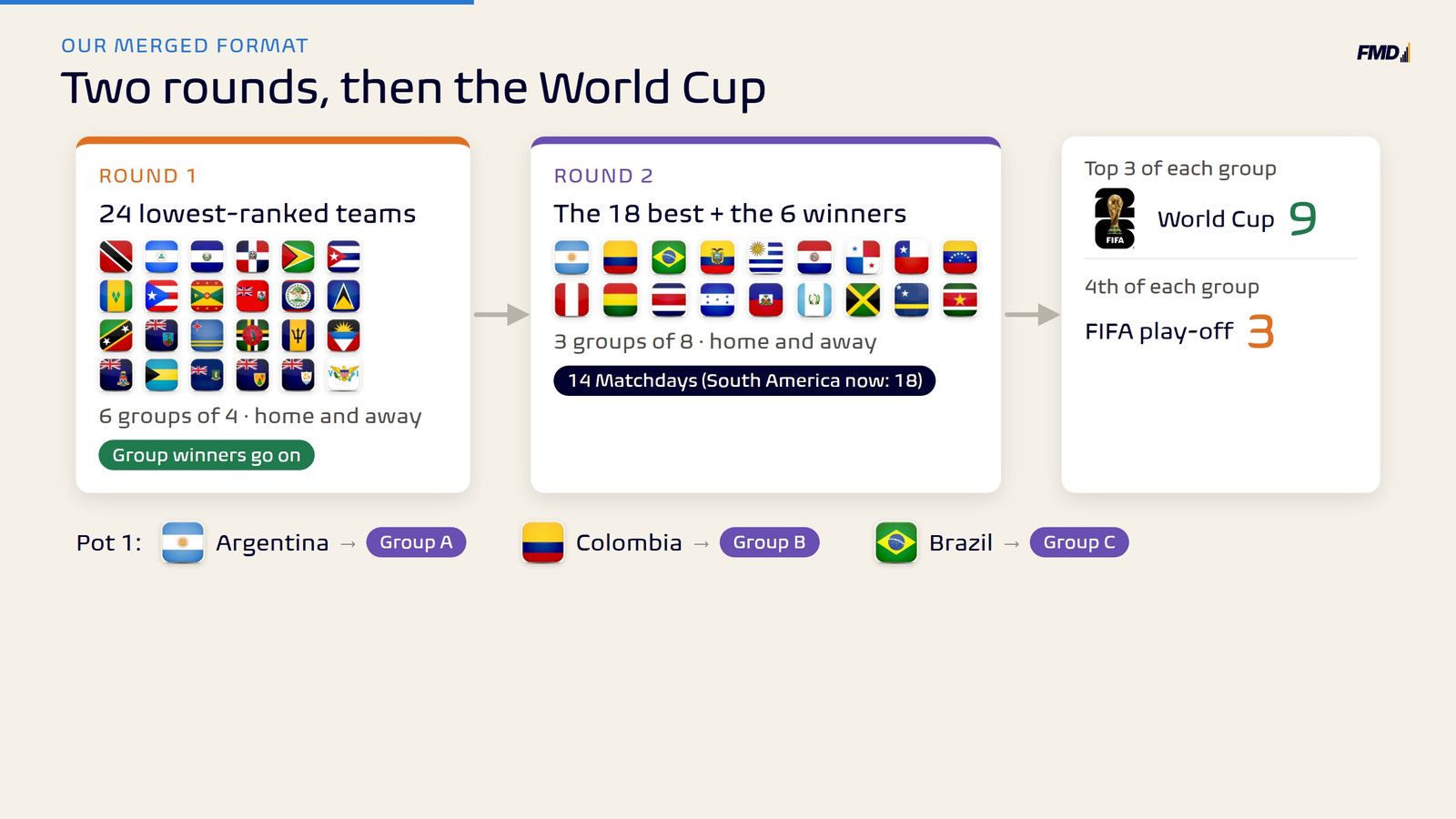
The rankings decide the pots, so the three strongest teams, Argentina, Colombia and Brazil, always land in different groups. Which means South America would lose one thing straight away: Argentina against Brazil. Twice every cycle in the current format. Never, in this one.
One possible draw
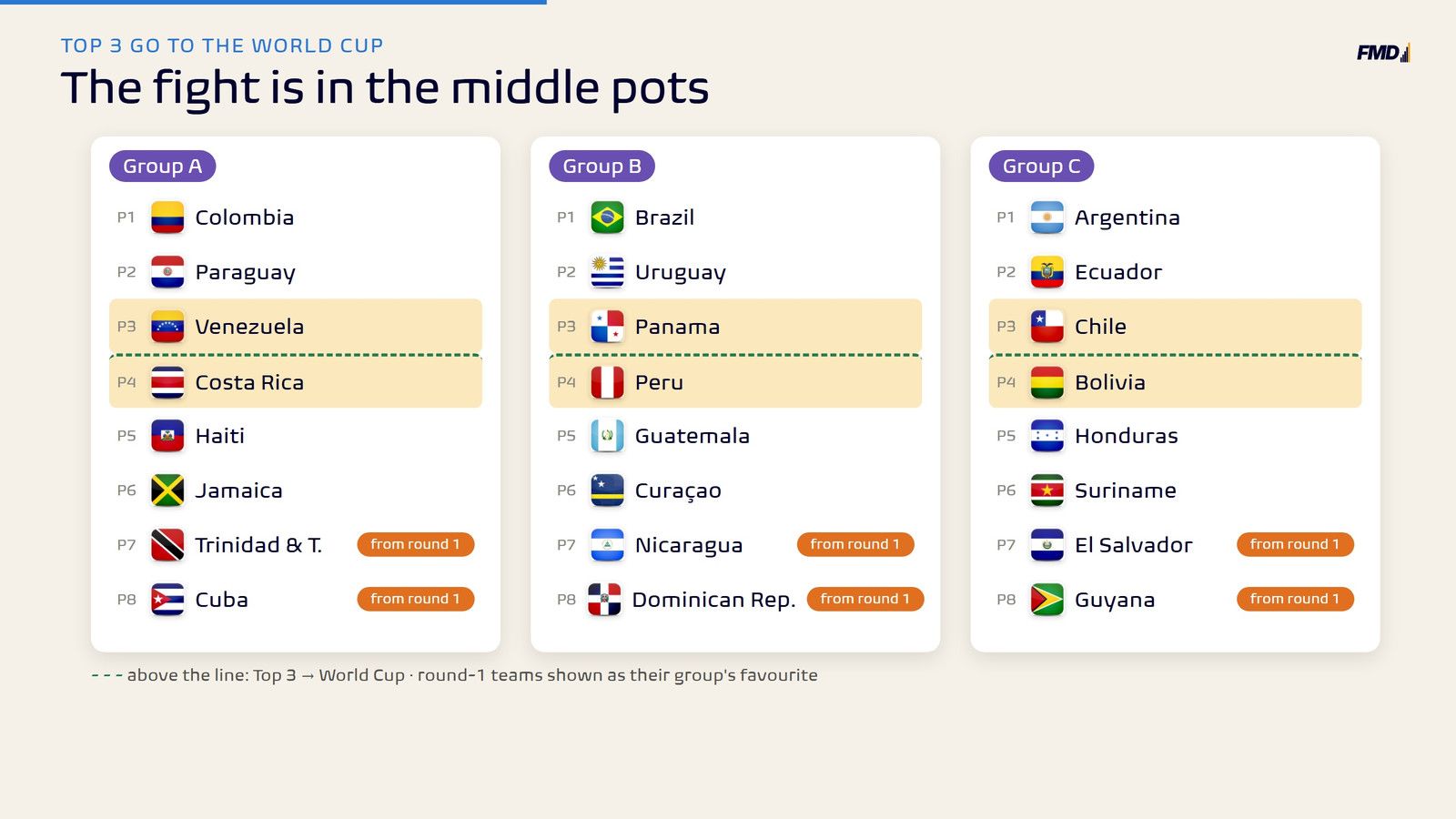
| Group | Pots 1 to 4 | Pots 5 to 8 |
|---|---|---|
| A | Colombia, Paraguay, Venezuela, Costa Rica | Haiti, Jamaica, Trinidad and Tobago, Cuba |
| B | Brazil, Uruguay, Panama, Peru | Guatemala, Curaçao, Nicaragua, Dominican Republic |
| C | Argentina, Ecuador, Chile, Bolivia | Honduras, Suriname, El Salvador, Guyana |
Every group gets one of the big three, then one of Ecuador, Uruguay and Paraguay. After that it's a mix of South America's middle and Central America's best. Look at the next two pots: Panama, Chile and Venezuela, then Peru, Bolivia and Costa Rica. With three places per group, that's where the fight is.
To play it out, we used every team's Elo rating at the end of 2025, after the real qualifiers, and the same match model as in our other World Cup simulations. Then we ran the whole campaign 20,000 times, with a fresh draw every time.
Who prevails?
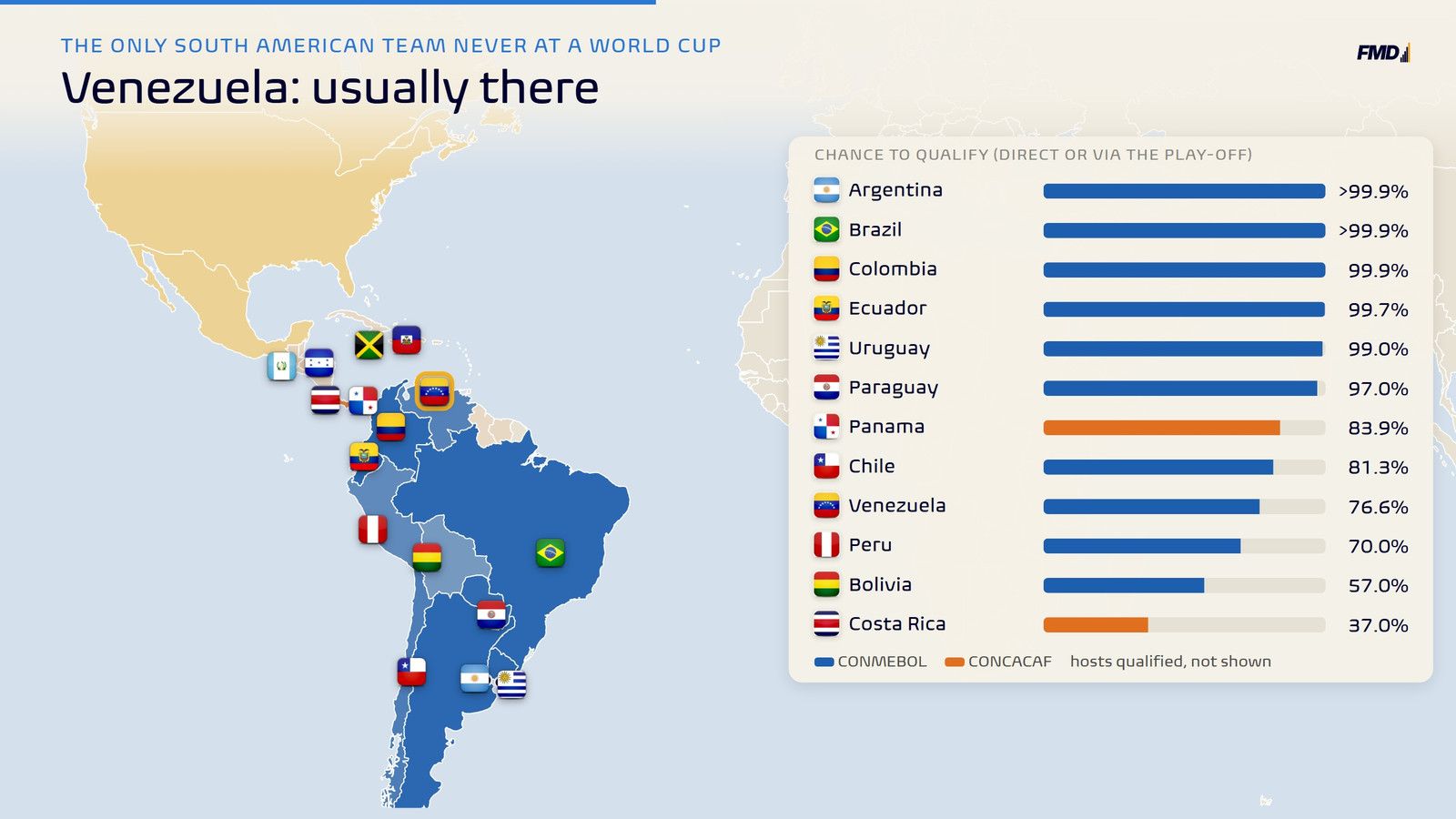
South America's top six are as good as certain: Argentina, Colombia, Brazil, Ecuador, Uruguay and Paraguay qualify in almost every run. Then comes the middle. Panama make it about five times in six, Chile 81.3% of the time, and Venezuela about three times in four.
That's the headline. Venezuela are the only South American country that has never played at a World Cup. In a merged qualifier, they would usually be there. Peru make it 70.0% of the time, Bolivia just over half, Costa Rica 37.0%.
The single most likely nine? South America's eight best, plus Panama. That exact set comes up 20.3% of the time, about once in every five runs.
Who gains, who loses
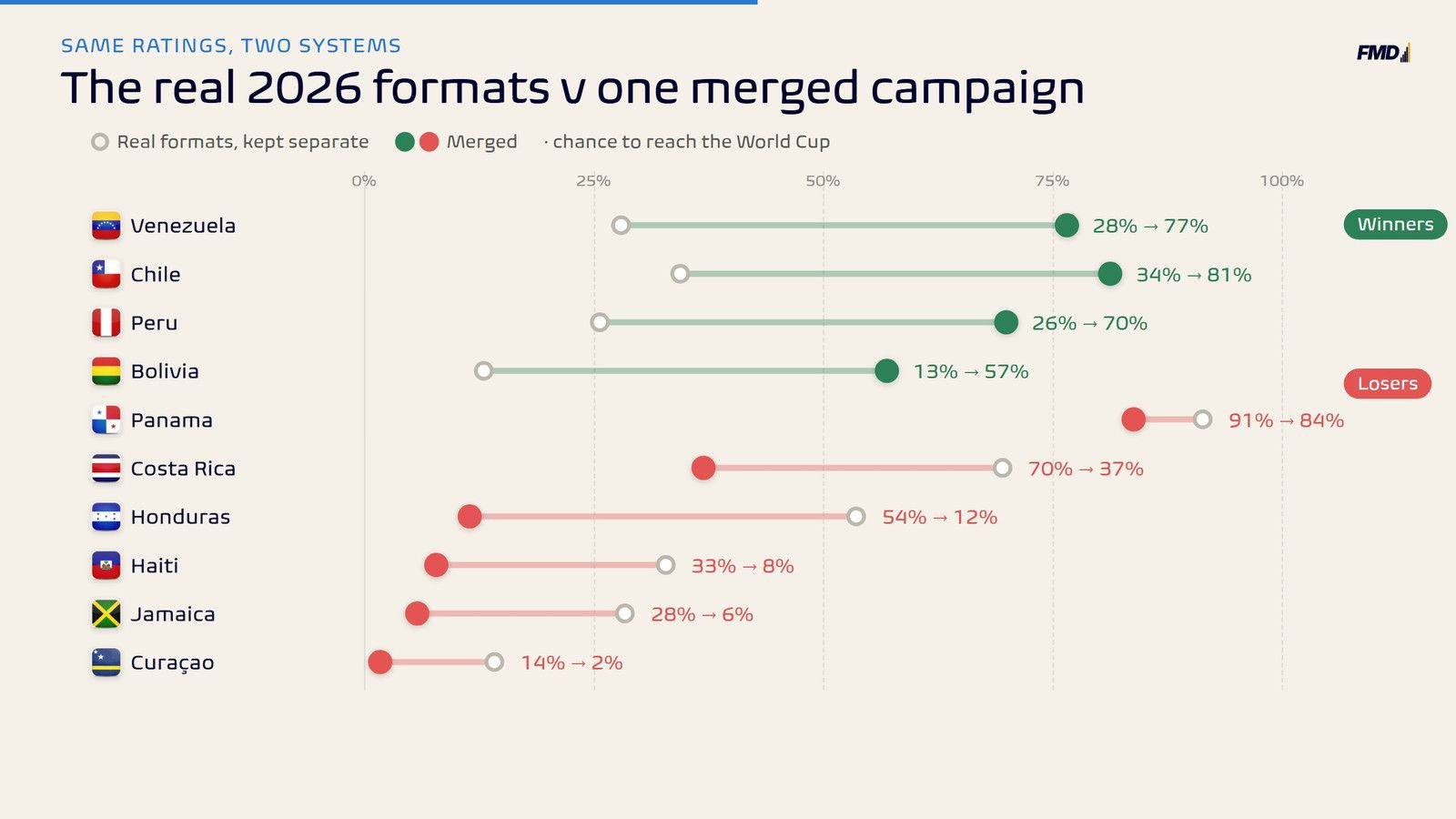
Now the fair comparison. We also replayed the real 2026 formats, separately, on the same ratings. That shows who a merger would really help, and who it would hurt.
| Team | Confederation | Real formats, kept separate | Merged |
|---|---|---|---|
| Argentina | South America | >99.9% | >99.9% |
| Colombia | South America | 99.6% | 99.9% |
| Brazil | South America | 99.4% | >99.9% |
| Ecuador | South America | 97.6% | 99.7% |
| Uruguay | South America | 93.6% | 99.0% |
| Paraguay | South America | 81.0% | 97.0% |
| Panama | CONCACAF | 91.4% | 83.9% |
| Chile | South America | 34.5% | 81.3% |
| Venezuela | South America | 28.0% | 76.6% |
| Peru | South America | 25.7% | 70.0% |
| Bolivia | South America | 13.1% | 57.0% |
| Costa Rica | CONCACAF | 69.6% | 37.0% |
| Honduras | CONCACAF | 53.6% | 11.5% |
| Haiti | CONCACAF | 32.9% | 7.8% |
| Guatemala | CONCACAF | 28.8% | 6.6% |
| Jamaica | CONCACAF | 28.4% | 5.8% |
| Curaçao | CONCACAF | 14.2% | 1.8% |
| Suriname | CONCACAF | 10.0% | 0.9% |
Chance to reach the World Cup, directly or through the intercontinental play-off. The hosts are left out: they qualify either way.
The winners are South America's middle class. Venezuela go from a bit over one in four to three in four. Chile and Peru more than double their chances, and Bolivia's go up more than four times.
The losers are everyone in CONCACAF below Panama. Costa Rica's chances halve. Honduras fall from just over one in two to about one in eight. Haiti, from one in three to 7.8%. And Curaçao, from 14.2% to 1.8%.
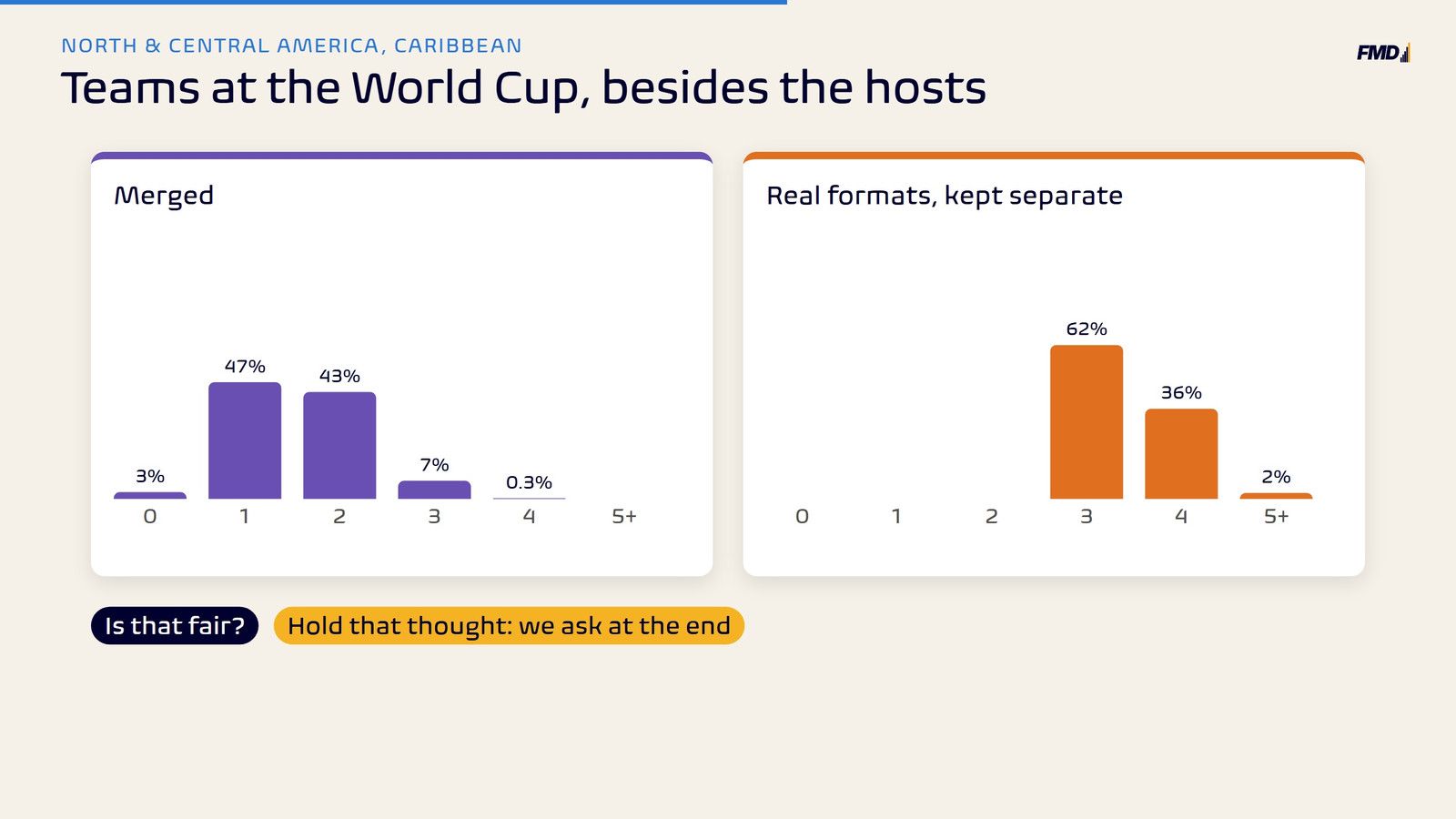
| CONCACAF teams at the World Cup, besides the hosts | Merged | Real formats |
|---|---|---|
| 0 | 2.8% | never |
| 1 | 46.7% | never |
| 2 | 42.7% | never |
| 3 | 7.4% | 61.6% |
| 4 | 0.3% | 36.0% |
| 5 | <0.1% | 2.4% |
Add it up, and North and Central America would send one or two teams besides the hosts, 89.4% of the time. On the real formats it's at least three, every time, because CONCACAF's three direct places are its own.
Would the World Cup have missed them?
Haiti, Curaçao and Panama played nine games between them at the World Cup this summer. They won none, drew one, and scored 3 goals while conceding 21. All three went out in the group stage.
| Team | Won | Drawn | Lost | Goals |
|---|---|---|---|---|
| Haiti | 0 | 0 | 3 | 2-8 |
| Curaçao | 0 | 1 | 2 | 1-9 |
| Panama | 0 | 0 | 3 | 0-4 |
That's a small sample, and fairytales are part of what makes a World Cup. But it's the strongest argument the merger has.
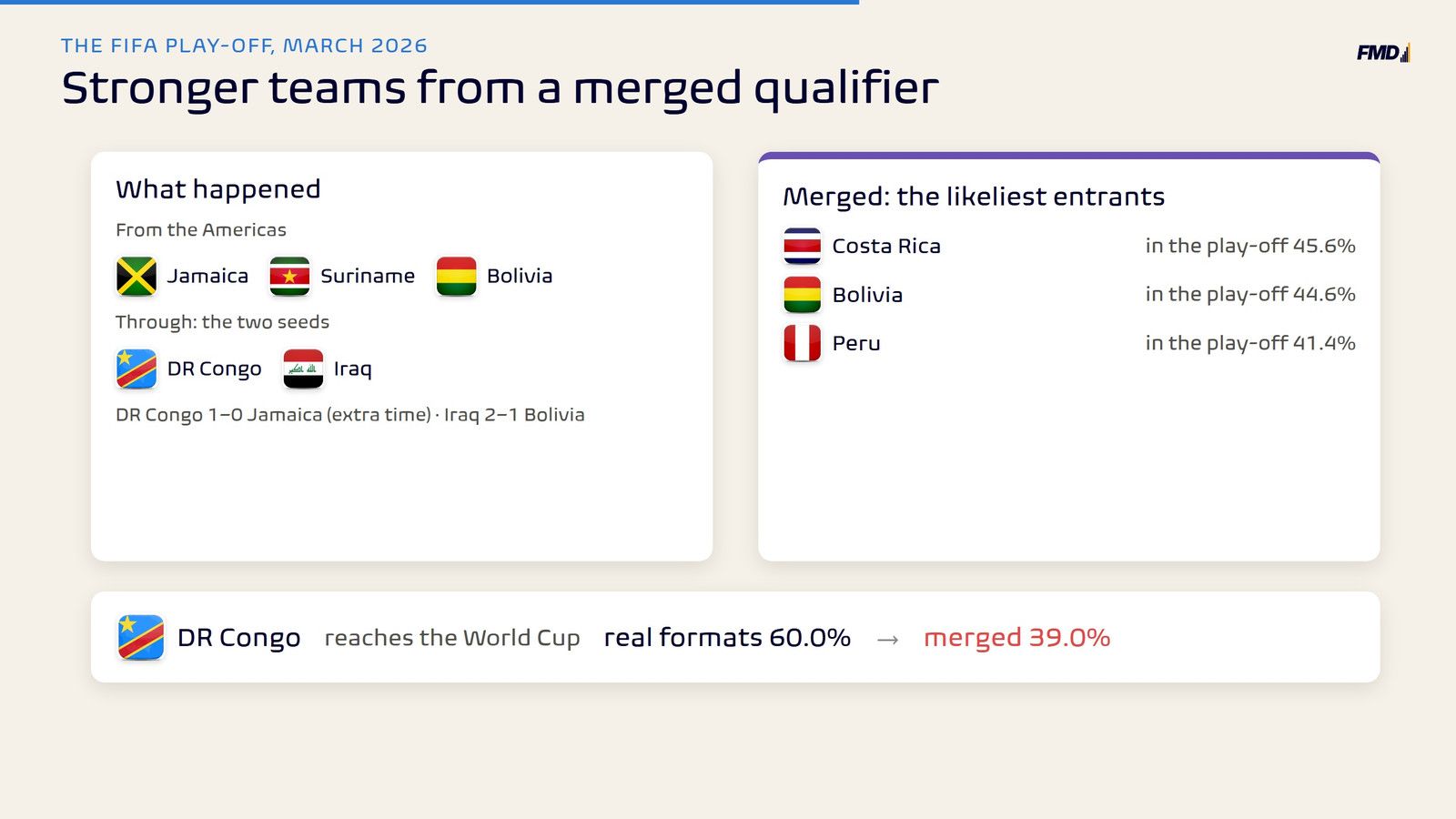
There's a knock-on effect too. A merged qualifier would send stronger teams to the intercontinental play-off: Costa Rica, Bolivia or Peru, rather than Jamaica and Suriname. DR Congo, who won their place there in March, would get through 39.0% of the time instead of 60.0%.
At 64 teams, the idea starts to make sense
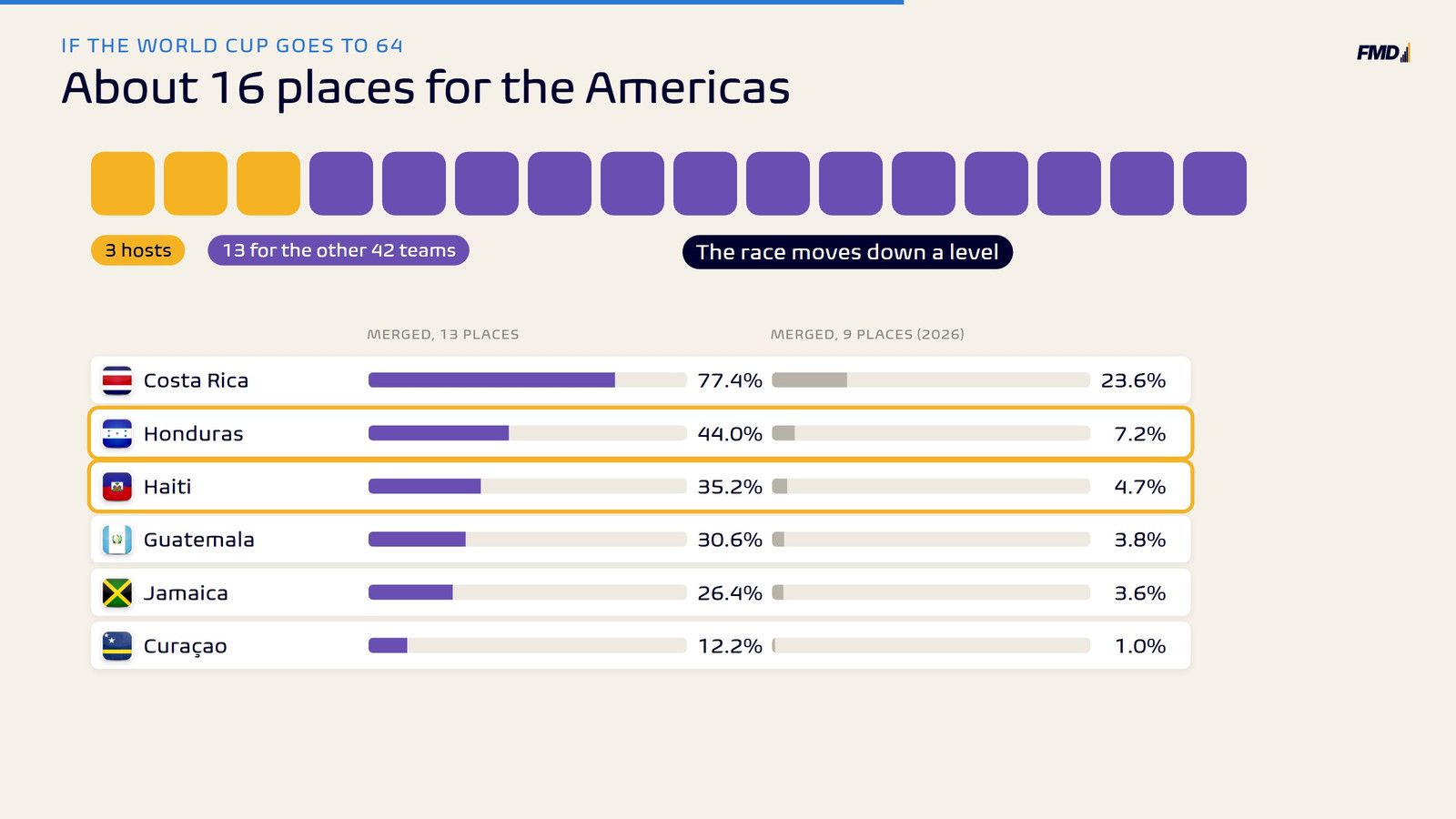
In a 64-team World Cup, the two would share about sixteen places. Merged, that's thirteen for the 42 teams after the hosts, and the race moves down a level:
| Team | Merged, 48 teams | Merged, 64 teams |
|---|---|---|
| Costa Rica | 37.0% | 77.4% |
| Honduras | 11.5% | 44.0% |
| Haiti | 7.8% | 35.2% |
| Guatemala | 6.6% | 30.6% |
| Jamaica | 5.8% | 26.4% |
| Curaçao | 1.8% | 12.2% |
At 64 teams: direct places only (13 after the hosts), no play-off assumed.
Kept separate, South America would play eighteen matchdays to knock out two teams. Merged, there's still a real race for the places. If expansion is draining the meaning out of qualifying, this is the best case for merging.
When the USA, Mexico and Canada have to qualify
In 2026 the three hosts didn't have to qualify. For 2030 and beyond, they will. So we ran it again with all 45 teams, for a 48-team and a 64-team World Cup.
- 48 teams: the two would share twelve direct places and two play-off tickets. Our format stretches to three groups of nine, and the top four go straight through (with the two best fifth-placed teams in the play-off).
- 64 teams: sixteen direct places.
The comparison is CONCACAF's own format for 2030 and South America's league, kept separate.
| Team | 48 teams, separate | 48 teams, merged | 64 teams, separate | 64 teams, merged |
|---|---|---|---|---|
| USA | 91.1% | 78.0% | 97.6% | 97.3% |
| Mexico | 96.9% | 94.8% | 99.4% | 99.8% |
| Canada | 95.1% | 89.5% | 99.0% | 99.5% |
| Panama | 86.5% | 72.6% | 96.1% | 96.9% |
| Costa Rica | 68.4% | 27.8% | 86.2% | 78.6% |
| Honduras | 51.4% | 8.1% | 73.7% | 44.2% |
| Haiti | 29.8% | 5.4% | 59.5% | 35.1% |
| Jamaica | 26.0% | 3.9% | 55.7% | 26.1% |
| Chile | 19.3% | 69.8% | 65.1% | 96.1% |
| Venezuela | 14.8% | 63.9% | 56.9% | 94.7% |
| Peru | 13.1% | 51.6% | 53.7% | 93.4% |
| Bolivia | 6.0% | 37.6% | 33.6% | 87.0% |
Chance to go straight through to the World Cup (direct places only).
Mexico and Canada would still be fairly safe. But the USA would go straight through only 78.0% of the time, against 91.1% on CONCACAF's own format. Chile and Venezuela would go straight through about two times in three, instead of less than one in five.
At 64 teams it's the same story one level down. Honduras, Haiti and Jamaica, all better than even on CONCACAF's own format, would fall below half, while Chile and Venezuela would be in about nineteen times in twenty, and Bolivia nearly nine in ten.
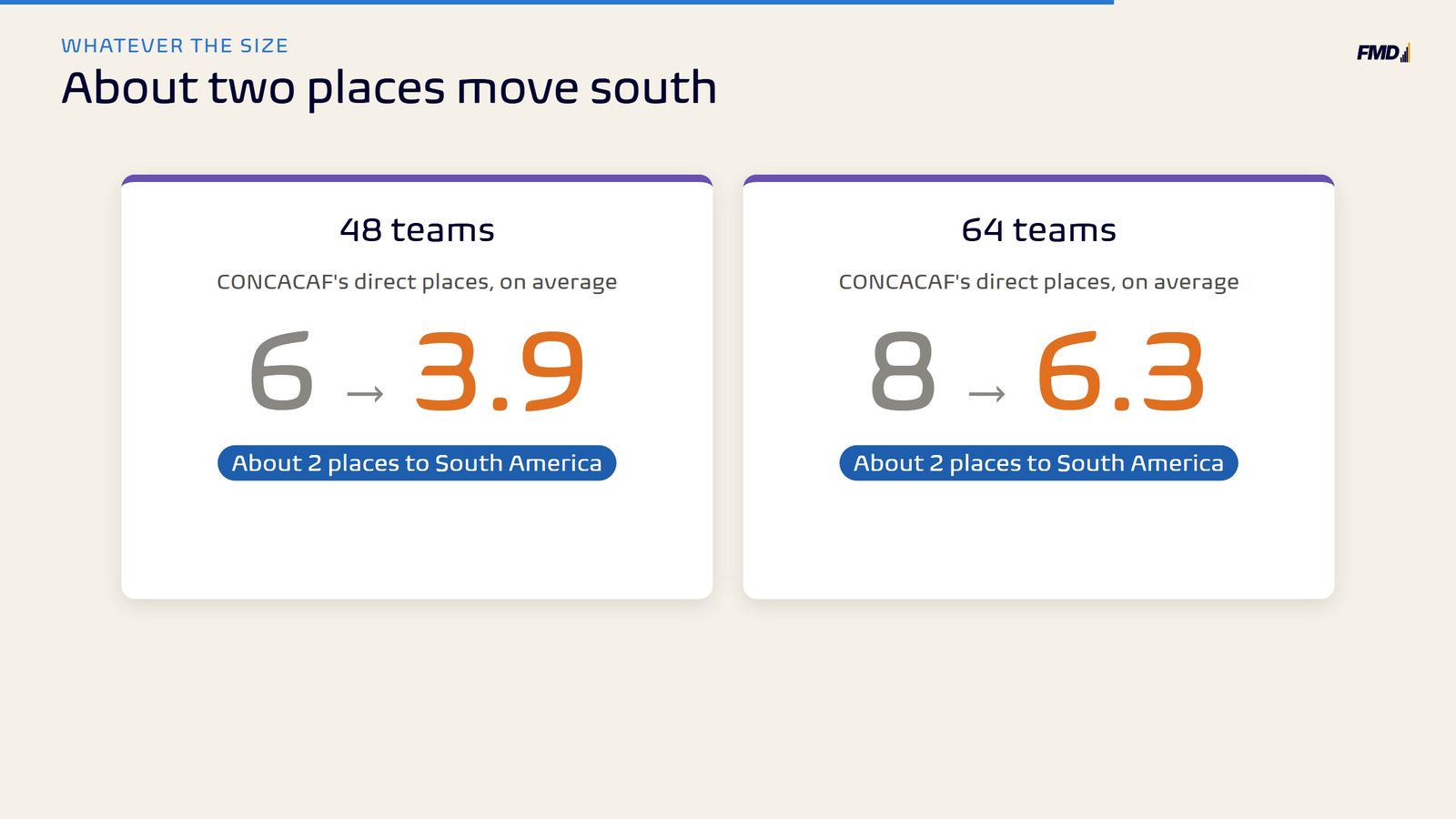
| World Cup | CONCACAF's direct places, own format | Merged, on average | Merged, most often |
|---|---|---|---|
| 48 teams | 6 | 3.9 | 4 |
| 64 teams | 8 | 6.3 | 6 |
So whatever the size of the World Cup, a merger moves around two places from North and Central America to South America.
The case for
- The places go to the strongest teams, so the World Cup gets a better field.
- Qualifying stays a real competition as the World Cup grows.
- Smaller countries get the big nights. Imagine Argentina or Brazil in Kingston or Guatemala City, with everything at stake. That's the kind of money and attention those federations rarely see.
- It tidies up the map. Guyana and Suriname are in South America, but they play in CONCACAF. In one qualifier, that stops mattering.
The case against
- The fairytales mostly disappear. CONCACAF's smaller nations would be playing for a play-off spot, at best. Curaçao's chance goes from 14.2% to 1.8%.
- The travel. Buenos Aires to Port-au-Prince is more than 6,000 kilometres. Then there's the altitude in Bolivia and Ecuador. And Haiti already have to play their home games abroad.
- It doesn't fix the giants' problem. In our runs Argentina, Brazil and Colombia are still safe with three or four matchdays to spare. A merger mostly swaps a trip to Montevideo for a trip to Port of Spain, and it loses Argentina against Brazil.
- Politics. Two confederations means two voting blocs at FIFA, each with its own seats on the FIFA Council. A merger asks both to give some of that up, and asks CONCACAF's members to vote away World Cup places.
So, should they merge?
On our numbers, a merger changes very little at the top: Argentina and Brazil qualify either way. What it does is move places from Central America and the Caribbean to South America's middle: Venezuela, Chile, Peru and Bolivia.
A stronger World Cup, or the end of stories like Curaçao's?
Over to you: should CONCACAF and CONMEBOL merge their qualifiers? Yes, no, or only if the World Cup goes to 64 teams? Tell us in the comments under the video.
Follow it on football-md.com
Follow the national teams with every team's chances updated as the games are played: the CONCACAF Nations League and the UEFA Nations League. And read how the places for 2030 could be shared out in our post on every confederation's World Cup places.
Numbers: our simulations, 20,000 runs on the World Football Elo ratings at the end of 2025 (after the last qualifying window), with the match model of our other World Cup simulations. Merged format: ours (45 teams; 24 in round 1, six groups of four, winners on; 24 in round 2, three groups of eight, home and away; top three direct, fourth to the FIFA play-off with DR Congo, Iraq and New Caledonia); real formats replayed on the same ratings. 64 teams: our split from the 64-team post (8 places each for CONCACAF and CONMEBOL). Hosts playing: three groups of nine, 12 direct + 2 play-off at 48, 16 direct at 64, against CONCACAF's own 2030 format and South America's league. Facts: World Cup 2026 qualifying and group stage results; Laureano González to Meridiano via Reuters, January 2017; Philippe Moggio to ESPN, January 2017.
📲 Follow the national teams from your phone
Install the Football Meets Data app to have the national-team tables and projections, updated after every match, one tap away. It takes a few seconds:
Android: open football-md.com in Chrome, tap the menu (⋮) and choose Install app.
iPhone: open football-md.com in Safari, tap Share and choose Add to Home Screen.
▶️ We're on YouTube
Watch next: how the World Cup 2030 places could be shared between every confederation. Subscribe to our channel so you never miss one.