UEFA Nations League: how the move from 4 to 3 leagues could work
13 July 2026
From the 2028/29 edition, the UEFA Nations League switches from four leagues of 16+16+16+6 teams to three leagues of 18+18+18: A, B and C. The 2026/27 edition, the last one played under the current format, decides who starts where.
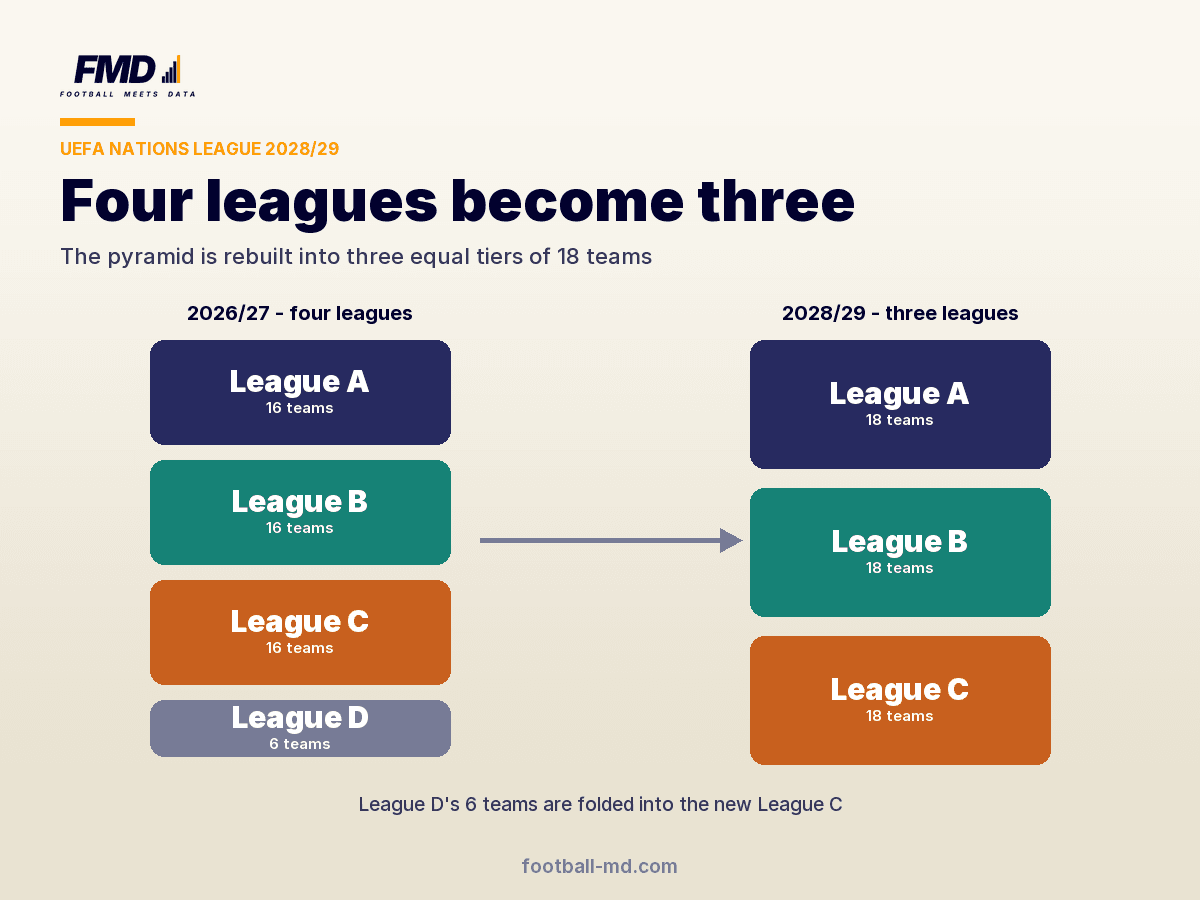
UEFA has confirmed the shape of the new competition but not the transition mechanics. Those are due at the Executive Committee meeting on 15 September 2026. What follows is the exploration of possible transition scenarios, set out purely by group position, assuming 54 teams with Russia still suspended.
We have received no information on how the transition will work, so this is only a speculation, our view on how it might work.
The baseline rests on two assumptions about what UEFA will want to carry over from the current format: the promotion and relegation playoffs stay, and group winners in the lower leagues keep a direct route up to the league above.
The starting point
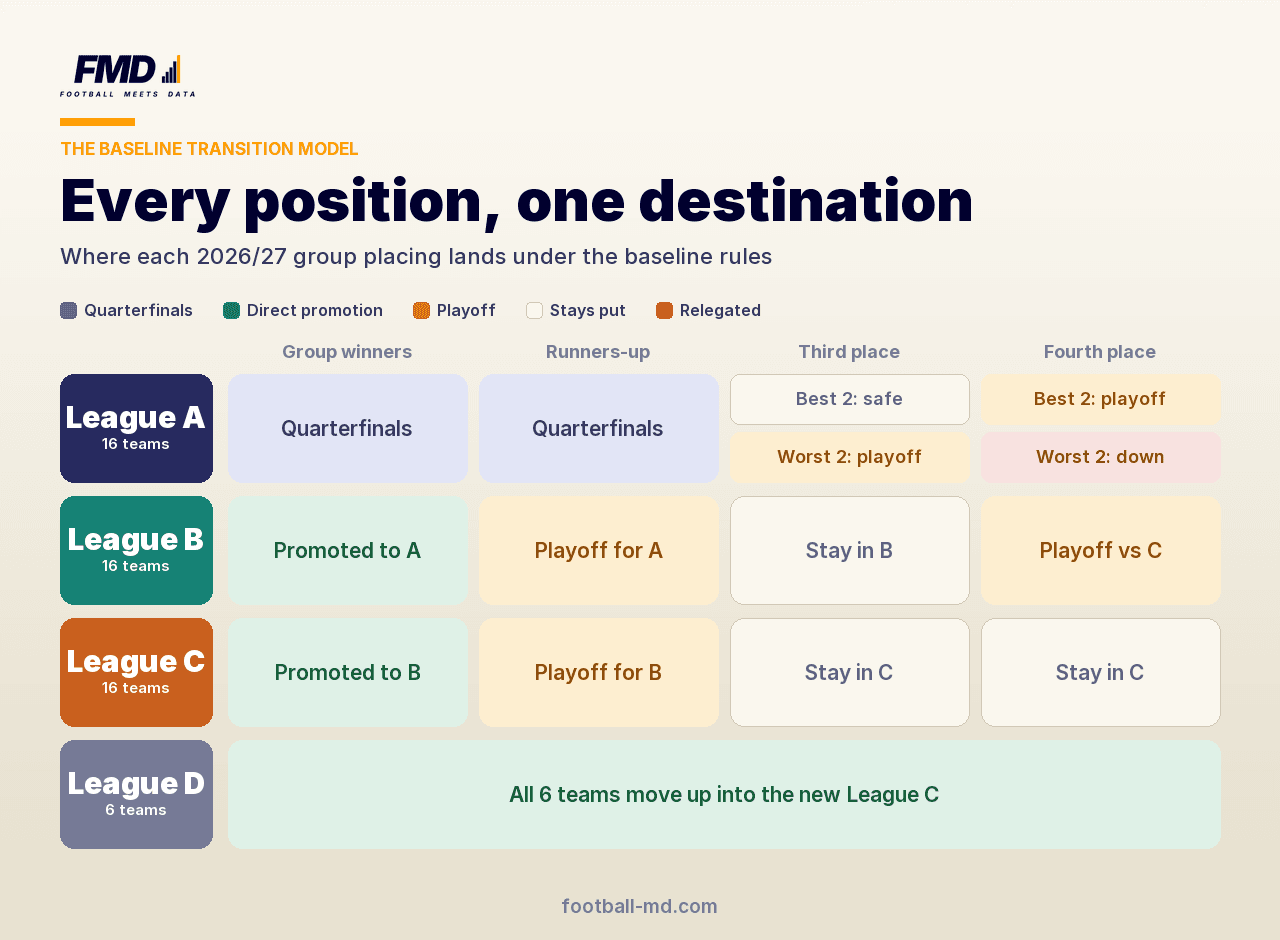
Each of the current Leagues A, B and C has four groups of four, so every league produces 4 group winners, 4 runners-up, 4 third-placed and 4 fourth-placed teams. League D has two groups of three. Those group positions are all the baseline model needs.
We start from bottom up.
League D is absorbed
League D is for sure abolished. All 6 of its teams will move up into the new League C, which becomes the only bottom tier. With nothing beneath them, they carry no relegation risk in 2026/27: the worst case is starting the new format exactly where it would put them anyway.
League C: four up, four in the playoff
In our baseline scenario, the four group winners are promoted directly to League B. The four runners-up get their shot as well, through a promotion playoff for a League B place. The eight teams that finish third or fourth stay in League C.
Losing 4 winners to B and absorbing all 6 League D teams leaves League C on exactly 18.
League B: no automatic relegation
The same logic applies one floor up. The four group winners are promoted directly to League A, and the four runners-up go into a promotion playoff for a League A place. The four third-placed teams are safe, while the four fourth-placed teams have to defend their spot in a relegation playoff against League C.
Nobody drops out of League B automatically in this scenario. Even a team that loses every game keeps a playoff lifeline in our baseline scenario. League B lands on 18.
League A: the only place with automatic relegation
The top tier has nowhere to promote to, and the top two in each group are chasing something else entirely: they advance to the Nations League quarterfinals and are untouched by the transition. For everyone else, it is about survival.
Among the third-placed teams, the two best are safe and the two worst go into a relegation playoff. Among the fourth-placed teams, the two best also get a playoff lifeline, while the two worst are relegated directly. That means 2 teams go down automatically and 4 more have to defend their place in the playoffs. League A lands on 18.
The playoffs
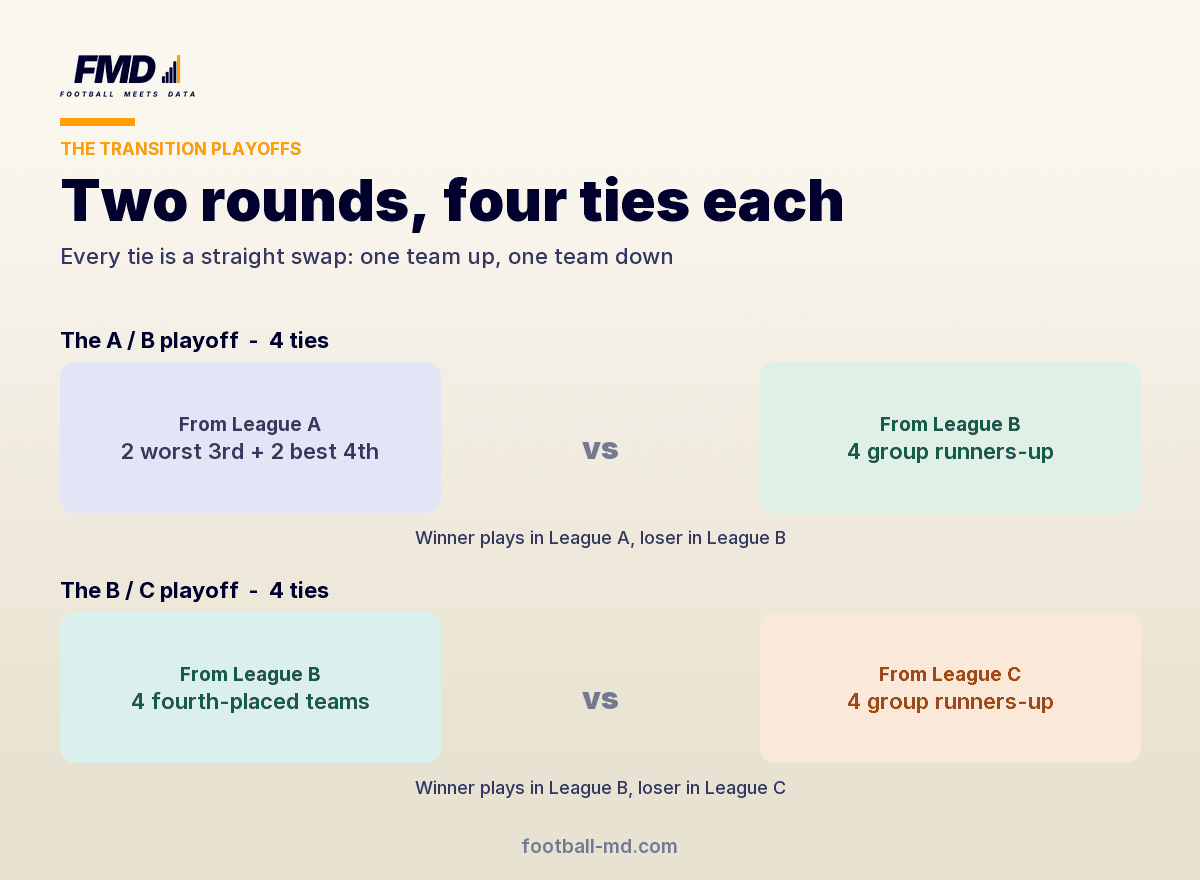
The transition ends with two playoff rounds, each 4 against 4, each tie a straight swap of one team up and one down.
In the A/B playoff, League A's four playoff teams, its two best fourth-placed sides plus its two worst third-placed, take on League B's four runners-up. The winner plays in League A, the loser in League B.
In the B/C playoff, League B's four fourth-placed teams meet League C's four runners-up, with the winner in League B and the loser in League C.
The totals
| Movement | Range |
|---|---|
| Relegated from League A | 2 to 6 |
| Promoted from League B | 4 to 8 |
| Relegated from League B | 0 to 4 |
| Promoted from League C | 4 to 8 |
| League D into new League C | all 6 |
Every league finishes on 18, and all 54 teams are accounted for.
The one open variable
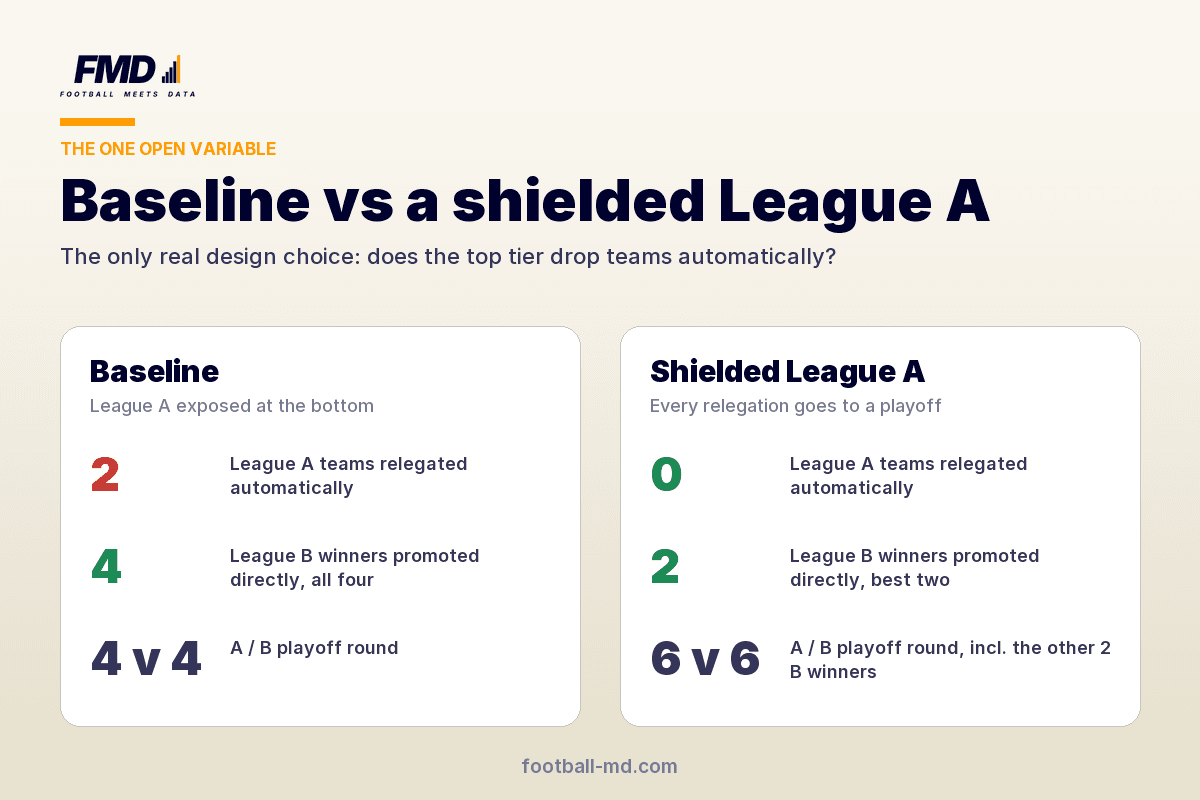
The baseline relegates 2 League A teams automatically. The alternative shields League A completely: promote only the two best League B group winners directly, send the other two winners into the playoff pool, and suddenly no League A team goes down automatically. Every relegation from the top tier would then be decided on the pitch, in a 6 against 6 playoff round. Everything below that boundary stays exactly the same.
There is also a possibility that UEFA abolishes the playoffs entirely, decrease the number of playoff ties, or cuts the 54-team field straight into a 18+18+18 split based on the UNL rankings at the end of the 2026/27 group stage. But we believe those to be somewhat less likely.
What happens next
UEFA's Executive Committee is expected to sign off the transition mechanics on 15 September 2026. Once the rules are locked and the 2026/27 groups are drawn, we will fold the transition into our Nations League simulations, so you can track every team's promotion odds, relegation odds and playoff probabilities matchday by matchday.
🔔 Get live alerts on your phone
Follow a team and we send you a push notification when a goal changes its chances, with the new probability in the message, and another one at the final whistle. How live match alerts work and how to switch them on.